Lady Dimitrescu as a game development case study
A nine-foot-tall villain in a wide-brimmed hat did not become one of the most talked-about characters in modern survival horror by accident. Lady Dimitrescu, the aristocratic antagonist of Capcom’s Resident Evil Village, was engineered across art, animation, mocap, audio, and narrative teams working in parallel, and the result is a useful case study in how a single boss-tier character can carry marketing, player memory, and fan-art ecosystems for years after launch. For developers, the interest is not the costume. It is the pipeline: how Capcom decided what a 9’6″ aristocrat should look like, how the RE Engine handled a body that tall, how the mocap team scaled a real performer up without breaking silhouette or combat readability, and how voice direction shaped a character whose face appears on screen for only a small fraction of total runtime.
This breakdown is written for developers, technical artists, animators, and producers who want to understand the decisions behind the character rather than collect trivia. It follows the same path a studio takes when green-lighting a signature antagonist: concept framing, silhouette and proportion targets, modeling, rigging, cloth and hair, motion capture, voice performance, AI behavior, narrative integration, and the technical compromises that the RE Engine forced on the team. Each section ends with a takeaway a smaller studio can apply to its own flagship NPCs, whether shipping a horror game, an action RPG, or a character-driven adventure.
Who Lady Dimitrescu is in the fiction
Within Resident Evil Village, Lady Dimitrescu is Alcina Dimitrescu, the eldest of four mutated sisters who rule the castle district of the rural village. She is presented as a former Romanian noblewoman, an aristocrat, a mother of many, and a hostess whose manners and dress contrast with the predatory scale and behavior of the rest of the game. She was originally conceived as a multi-faceted horror figure rather than a single-note jump-scare boss, and the development team at Capcom leaned on her cultural references, her scale, and her restraint to do most of the work that scripted scares usually carry. Her manner is closer to a Hammer Films aristocrat than to a Resident Evil 2 licker: she pours wine, she addresses Ethan by name, and she threatens him in the same calm sentence.
Her narrative role is narrow but precise. She pursues the protagonist Ethan Winters, she interrogates supporting cast members, and she controls a slice of the castle dungeon and the surrounding cellars. The design team deliberately kept her on screen for shorter windows than the other major antagonists so each appearance felt earned, and the writing team gave her just enough dialogue and manner to communicate a personality that players could project onto. That pacing decision shaped every downstream technical choice from animation length to lighting passes, and it is the kind of editorial constraint smaller teams can copy without buying a new toolset.
Within the broader Resident Evil canon, the character functions as a tonal pivot. The opening hours of Village lean on lycans, cold weather, and rural dread, and the castle sequence shifts the register to gothic horror, body horror, and a single pursuer who behaves like a hostess. That tonal shift is built into the character rather than imposed on her, which is why cosplay and fan art tend to focus on her as a costume first and as a monster second. The fictional scaffolding supports the design rather than competing with it.
The origin of the character and concept art
The earliest concept sketches leaned on classic gothic and Hammer horror references, including tall hats, opera gloves, long furs, and a posture that suggested both wealth and predator. Capcom’s art team studied tall villain archetypes and tested scale against the rest of the cast before settling on the final height. Early internal numbers reportedly sat in the eight-foot range, and the team pushed the value upward once the silhouette still read clearly at 9’6″. The point of the height is not the number, it is the contrast it produces against Ethan’s normal human frame, and the production team kept iterating until that contrast was visible from a 30-meter camera distance.
Concept work for the character also covered the castle architecture. The halls, doors, ceilings, staircases, and even the chandeliers were drawn to match her proportions so she would not look stuck in a human-sized set. For developers, that is the real lesson: a character of unusual scale demands a stage drawn to that scale, otherwise animation and cinematography look broken no matter how good the model is. The castle was authored to make the character feel inevitable, and the character was authored to make the castle feel occupied. The two assets were co-designed, and that co-design is the part of the production that other teams rarely replicate.
The art team also worked through several alternate silhouettes before locking the dress, the hat, and the color palette. Internal revisions reportedly included a tighter silhouette, a darker palette, and a shorter brim, and each variant was tested at thumbnail size to see whether the character still read in marketing crops and on storefront cards. The final silhouette was the one that survived every crop, and the final color palette was the one that survived every background. That kind of cross-discipline test is rare in mid-budget productions, and it is part of the reason the character reads cleanly in screenshots, trailers, and 30-second social clips.
How RE Engine handled a 9’6″ character model
Resident Evil Village runs on Capcom’s RE Engine, the same in-house engine that shipped Resident Evil 7 and would later power Resident Evil 4 (2023) and the newer Dragon’s Dogma titles. From a technical standpoint, a very tall NPC does not break the engine. The same skeleton, blend tree, and physics constraints that drive a normal-sized enemy can drive a scaled one, provided the team accounts for a few specific problems:
- Joint limits and IK targets: a 9’6″ skeleton has longer bones, so the angle of every joint has to be re-evaluated so motion-capture data does not produce over-bent elbows or shoulders that clip into the dress.
- Camera framing: cinematic cameras that frame at eye level need adjusted boom lengths and FOV so the head does not push past the top of the screen in chase sequences.
- Foot IK and step distance: a longer leg means a longer stride, so walk and run cycles have to be retimed or remixed so the character still feels grounded on cobblestone and wooden floors.
- Hitbox alignment: gameplay hitboxes for claws, grabs, and stomps must be re-aligned with the animated geometry or combat will feel disconnected.
- Lighting and shadow falloff: a tall body casts longer shadows, and contact shadows from the hat brim behave differently at scale, so the lighting team has to re-bake contact and ambient occlusion passes for the character.
- Audio occlusion: a tall head sits further from a player’s ear in mix terms, so the audio team has to re-evaluate distance cues and reverb sends for dialogue lines and barks.
Capcom’s pipeline for the character was a standard character production path at the scale of a flagship title: high-poly sculpt in ZBrush or an equivalent package, retopology for the RE Engine target, UV layout, and a dense texture set for skin, hat, dress, gloves, and jewelry. For developers used to working on mid-budget projects, the most expensive part of that pipeline is not the model itself but the texture density. A character visible in close-up cinematics needs normal, roughness, specular, sub-surface, and cavity maps at a resolution that would crush a memory budget on a last-generation console, so teams that copy this approach on smaller projects usually drop the resolution and lean on lighting to recover the look.
The team also had to author collision volumes for a body that did not match the rest of the cast. Standard capsule colliders tuned for human-sized NPCs would have let the character clip into the floor on long strides and clip through the dress on tight turns, so the collision pass was rebuilt with multiple stacked shapes per bone group. That kind of pass is invisible to players, but it is the kind of work that prevents the character from looking like a model standing on a hidden cylinder, and it is the kind of work that a smaller team will skip if it does not budget for it up front.
Rigging, cloth, and hair: where most of the budget went
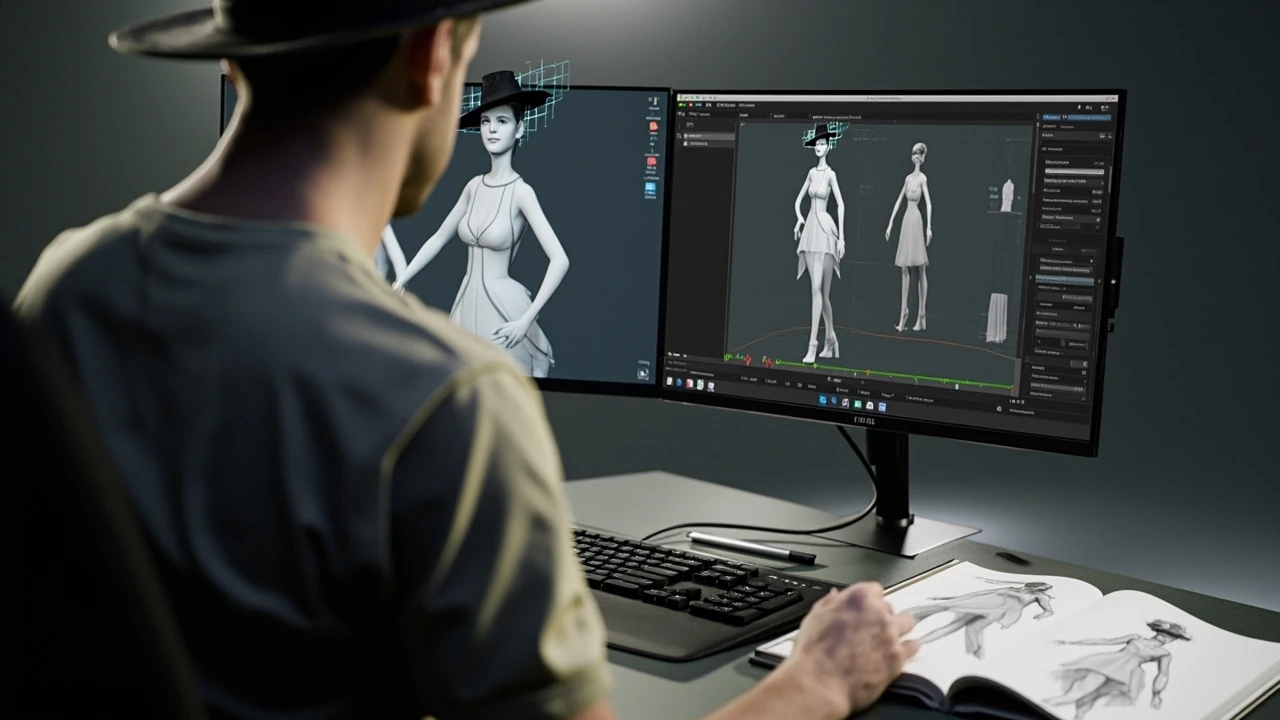
For an aristocratic character with a floor-length dress, a wide hat, long gloves, and tied hair, rigging is the most expensive part of the asset. The skeleton has to support deformation across torso, shoulders, arms, and neck for performance animation. Cloth simulation has to handle a heavy wool-style dress, an underskirt, and a wide hat brim in a way that survives gameplay, not just cutscenes. Hair has to be card-based, strand-based, or hybrid, and it has to be authored so the silhouette does not collapse into the dress when the character turns.
| Subsystem | What the team had to solve | Typical cost driver | Cheaper-team workaround |
|---|---|---|---|
| Rig | Long bones require re-baked joint limits and IK targets | Re-authoring mocap clips | Procedural stretch and corrective blend shapes |
| Cloth | Heavy dress and hat must survive gameplay, not just cinematics | Physics solver overhead and asset authoring | Vertex-animated cloth baked from simulation |
| Hair | Tied hairstyle must read at distance without merging with the hat | Strand count and shadowing cost | Hybrid card system with low-cost strand pass |
| Skin | Close-up cinematics need sub-surface and pore-level detail | Texture memory and shader cost | Drop texture resolution, lean on lighting |
| Collision | Stacked colliders per bone group to avoid floor and dress clipping | Physics query cost per frame | Simplify per-bone shapes, test on a stress scene |
| Hat and props | Hat brim must stay level during walk and turn | Constraint solver tuning | Drive the hat from a small handful of bones with damped limits |
The general lesson is that cloth and hair are a larger share of the budget than the body itself, and teams that underestimate this end up shipping characters that look correct in screenshots and broken in motion. The Verge’s coverage of the character during the 2021 marketing cycle focused heavily on the perceived height, and the piece is a useful reminder of how a single exaggerated spec can dominate public conversation even when the engineering work that actually shipped the character was happening in cloth and hair.
For smaller teams, the most useful move is to budget cloth and hair as a separate line item at greenlight, not as part of the character art milestone. A team that budgets the body, the dress, and the hair together tends to push the body and let the cloth and hair slip. A team that budgets each subsystem separately tends to ship a more stable character, even at a lower polygon count. The discipline of line-item budgeting is dull and unglamorous, and it is the single biggest reason mid-budget characters look right in motion.
Motion capture, performance, and animation choices
Capcom captured performance on stage with a real actor for the body, and the animation team later scaled the result in-engine to match the final 9’6″ frame. The body language of the character was the priority: a slow, deliberate walk, a learned posture, an exaggerated shoulder turn. None of those behaviors come from a real 9’6″ human, they were achieved by retargeting and amplifying a normal-sized performer’s motion so the silhouette still felt grounded. For developers, that is the interesting part. The motion library was authored for a human of average height, then re-timed and re-curved at the character level to extend the stride and slow the cadence, which is faster and cheaper than capturing a tall performer and then fixing joint-limit problems across the entire clip set.
- Walk cycle: long stride, deliberate foot placement, slight shoulder tilt so the hat brim stays level.
- Combat stomp: a one-step windup, a heavy downward claw strike, and a follow-through with the opposite arm for balance.
- Dialogue beats: a closed-lip, restrained delivery with a slight head tilt to expose the hat brim as a framing device.
- Death animation: a wide, slow collapse, which is harder to sell than a fast kill because the rig has to read at the height of a room.
- Idle stance: a long, almost still pose with a small shoulder rise on the breathing curve, used as the base layer for combat transitions.
- Turn in place: a slow, weight-shifted turn that keeps the hat brim as the visual line, used for camera resets and scripted moments.
For animators, the relevant question is not how you animate a tall character but how you preserve body language at scale. The answer is almost always the same: capture at one scale, re-author at another, and use a layered blend tree to preserve the original intention. For additional context, A Verge piece on the character’s in-game height captures the public framing of the character during the launch window, and it is worth reading alongside the production notes because it shows how the team’s restraint on screen time and exaggeration on silhouette fed directly into the marketing conversation.
The team also had to deal with vertical chase sections, which is the part of the animation set that smaller teams often under-build. A boss that chases a player up staircases, across catwalks, or through tall doorways needs a separate set of locomotion clips authored for slopes and stairs, and those clips do not come for free from a standard walk cycle. The castle sequence in Village leans on those vertical clips, and the production work to build them is part of the reason the chase sections feel grounded instead of floaty.
Voice direction and audio design
Lady Dimitrescu’s voice was performed by a real actress and treated in post with a combination of pitch correction, formants, and reverb to land somewhere between a natural alto and a low, dry contralto. For additional context, The Wikipedia entry for the character documents the voice cast and the studio credit, which is the right level of detail for a developer looking at the audio pipeline. Capcom did not invent her voice with a synth; they shaped it. For audio engineers and voice directors, that is the relevant fact. The voice had to read as aristocratic and slightly amused without ever breaking into caricature, and the formants were tuned so the character sounded like a single coherent person whether she was whispering in a dungeon or shouting across a courtyard.
The mix also used distance and material cues: dialogue in stone halls carried a long reverb, dialogue in the dungeon was drier and closer, and cinematics sat on a separate bus with a more compressed dynamic range. For smaller studios, the lesson is that the character’s voice was a separate creative deliverable, not a side effect of casting. The same recording, treated the same way, would not have read as a single character if the mix had been a single bus. The team treated the voice as a layered asset with its own routing, and that routing is the kind of work that does not show up in a press release but shows up in the final mix.
The audio team also had to handle barks, grunts, and combat vocals that had to match the on-screen motion. A stomp needed a thud and a layered fabric impact, a claw swipe needed a dry whoosh and a contact layer, and the death sequence needed a slow, sustained vocal fall that lined up with the rig’s collapse animation. None of those layers were free, and none of them came from a stock library, which is part of the reason the character sounds like a finished character rather than a library character with a costume on top.
Combat, AI, and boss behavior
As a boss, Lady Dimitrescu uses three patterns that developers can study without copying. First, the encounter telegraphs a phase change by changing the camera framing rather than swapping the character model, so the player reads the difficulty shift from a visual cue that the team did not have to model. Second, the boss uses environmental scaling to feel larger than her animation set, by raising the ceiling, opening the room, and using vertical chase sections that the player can read at a glance. Third, the boss transitions between melee and ranged behaviors in a way that reuses the same walk and idle clips, so the team did not have to animate a separate combat stance.
| AI pattern | Player-readable cue | Asset reuse strategy | Production benefit |
|---|---|---|---|
| Approach | Long walk cycle with the hat brim tilted toward the player | Reuses exploration locomotion set | Avoids a separate combat walk |
| Claw swipe | Single-step windup with shoulder rotation | Reuses the combat idle as the start frame | Reduces new clip count |
| Stomp | One-foot lift and a heavy downward impact | Reuses the walk pose with a different end frame | Maintains silhouette consistency |
| Flee | Reverse walk and a fast shoulder turn | Reuses the same clips in reverse | Keeps the encounter readable |
| Phase change | Camera pulls up and the ceiling rises | Reuses the same character with a new framing rig | Avoids a new boss model |
| Vertical chase | Stair and catwalk locomotion set | Reuses slope and stair clips from exploration | Keeps the budget realistic |
From a design standpoint, the AI is doing the same job as any boss in the genre: giving the player a small readable vocabulary of attacks and asking them to learn it. The production interest is that the team did this without exploding the animation budget, by reusing the exploration locomotion set as the combat set. Smaller teams that copy this approach do not have to invent a new locomotion library per boss, which is the single biggest animation-cost lever in a flagship character.
The encounter also uses the castle as a constraint system. Doors, staircases, and low ceilings are placed so the player’s escape routes are readable, and the boss’s body language is tuned so the player can predict where the next attack will land. That kind of environmental authorship is invisible in a clip reel and visible in a playtest, and it is the kind of work that does not scale with budget. A smaller team that authors the stage around the character can ship a readable boss without shipping a larger animation set.
Why the character became a marketing event
By the time Resident Evil Village launched in May 2021, the marketing team had already let the character’s height, costume, and personality leak through trailers and previews, and the reaction in the broader internet turned her into a meme cycle before the first day-one patch. The Verge’s coverage of the character focused on the comparison between her in-game height and the tallest recorded human, which is itself a useful case study in how a single exaggerated number can become the most quoted line in marketing copy. The developers who later worked on cosplay, fan art, and merchandise ecosystems were responding to a design that had been deliberately exaggerated at concept stage, which is itself a useful decision to study.
- Exaggerated spec: 9’6″ is a memorable number that survives being quoted out of context.
- Clear silhouette: a tall hat, a long dress, and a wide hat brim read at any thumbnail size.
- Restraint: the character is on screen for a small fraction of total runtime, so each appearance feels earned.
- Personality: a single, readable manner (dry amusement, low voice, deliberate walk) makes fan art easy to author and easy to recognize.
- Costume legibility: the dress, hat, gloves, and color palette survive low-poly renders and cosplay builds, which feeds the fan-art loop.
- Meme-ready line reads: short, dry barks translate well into gifs and short clips, which feeds the social loop.
For studios, the relevant lesson is not to make a boss taller. It is to pick one exaggerated spec, one clear silhouette, and one readable personality, and protect those across art, animation, audio, and writing. A character that protects those three things will survive the marketing pipeline even if the rest of the production is conservative, and a character that fails on any one of them will struggle to land regardless of budget.
Production takeaways for game developers
Pulled together, the character is a useful case study in how a flagship NPC is shipped at the level of a triple-A release, and how smaller teams can borrow the same decisions at a lower budget.
- Pick the exaggerated spec early. If a character has a single big number, an unusual silhouette, or a memorable prop, decide what it is at concept stage and protect it through the entire pipeline.
- Draw the stage to match the character. Tall characters need tall rooms. Small characters need low ceilings. A character that does not fit its set looks broken in motion no matter how good the model is.
- Reuse the locomotion set as the combat set. A walk, a run, and a turn can carry most of a boss’s body language, which keeps the animation budget realistic.
- Treat the voice as a creative deliverable, not a casting artifact. Tuning formants, pitch, and reverb is what makes a character sound coherent across cinematics, gameplay, and barks.
- Be honest about cloth, hair, and skin. These are the most expensive parts of any character asset, and the place where smaller teams most often go over budget.
- Use the camera as a weapon. The character’s scale and personality are amplified by framing, by FOV, and by ceiling height, all of which are cheaper than re-authoring the model.
- Protect the on-screen budget. The character is on screen for a small fraction of total runtime, and that restraint is part of why each appearance lands.
- Budget per subsystem. Cloth, hair, skin, collision, and audio are separate line items, and the team that budgets them separately ships a more stable character.
- Test at thumbnail size. The character has to read in marketing crops, on storefront cards, and in 30-second social clips, not just in 4K cutscenes.
- Co-design the stage and the character. A tall character needs a tall set, and the two assets have to be authored together, not in series.
None of these lessons are unique to Lady Dimitrescu, but the way they were applied to a single character across a single release is a clean example of how a flagship NPC becomes a development pattern that other teams can study and adapt. The interesting part is not the height, the hat, or the voice. It is the discipline of protecting three or four decisions across every discipline on the team, and the willingness to cut anywhere else.
Frequently asked questions
Who is Lady Dimitrescu in Resident Evil Village?
She is Alcina Dimitrescu, the eldest of the four mutated sisters who rule the castle district in Resident Evil Village. She is a former Romanian noblewoman presented as a hostess, a mother, and a predator, and she is one of the four main antagonists the player confronts during the campaign.
Why is Lady Dimitrescu so tall in the game?
The height is a deliberate design exaggeration. The character was originally concepted in the eight-foot range and pushed to roughly 9’6″ because the silhouette still read clearly at that scale, and the contrast against the normal-sized protagonist made her immediately readable from any camera distance. The exaggerated number also became a marketing hook, which is part of why the design was protected through production.
How did the developers handle a character that tall in the engine?
The RE Engine handles scaled characters through the same skeleton, blend tree, and physics constraints as normal-sized ones, with extra work on joint limits, IK targets, foot placement, hitbox alignment, camera framing, and lighting passes. Capcom’s team captured performance at a normal scale and re-authored the data at the in-game scale, which was faster than capturing a tall performer and fixing joint limits across the entire clip set.
What engine is Resident Evil Village built on?
Resident Evil Village runs on Capcom’s in-house RE Engine, the same engine used for Resident Evil 7 and later titles in the franchise. The engine’s rendering, lighting, and character pipelines were the technical basis for the character’s look and animation, and the production decisions in this breakdown are all anchored to that engine’s capabilities.
How was the character’s voice performed?
A real actress recorded the performance on a standard stage, and the audio team treated the take in post with pitch correction, formant tuning, and reverb to land the character’s final voice. The result reads as a single coherent person across whisper, dialogue, and shouting scenes, which is what made the voice work feel like a creative deliverable rather than a casting artifact.
Why does the character have a wide-brimmed hat?
The hat is a silhouette device. It frames the face at close range, it reads at thumbnail size in marketing materials, and it stays level during animation to give the character a stable visual line. Concept art at Capcom explored a range of headwear options, and the wide-brimmed hat was kept because it carried the silhouette across art, animation, and marketing without redrawing the character.
Did the developers plan for the character to become a meme?
The team did not set out to design a meme, but the exaggerated spec, the clear silhouette, and the restrained screen time were the conditions that let the character become one. The combination of a memorable number, a readable costume, and a personality that is easy to imitate is what gave fan art, cosplay, and parodies enough material to work with before launch.
What can smaller studios learn from this character?
The relevant lessons are not the height, the hat, or the dress. They are the decisions: pick one exaggerated spec early, draw the stage to match the character, reuse locomotion as combat animation, treat voice as a creative deliverable, budget for cloth and hair honestly, and use the camera to amplify the design. Smaller teams that apply these decisions in proportion to their own scope can ship flagship NPCs without the budget of a triple-A release.
How much of the character was animated versus captured?
Body language was captured on a mocap stage at a normal scale and re-authored at the in-game scale, while combat-specific stomp and claw clips were hand-keyed or blended on top of the captured set. Face animation in cinematics was also captured and re-targeted, and the final delivery layer was added in post.