Gears of War E-Day Tips for Veterans Who Need to Unlearn Things
Here’s the thing that’ll catch anyone who’s put hundreds of hours into Gears 5. The Coalition didn’t tune this game. They rebuilt it, and they said so out loud months before launch. Four systems got torn down and reassembled – cover, movement, weapons, enemies – and the stated goal on the movement side was to encourage commitment, momentum, and weight. Which is a polite way of saying they wanted to kill hyper-bouncing.
So if your plan for launch day is to drop in and wall-bounce your way through Kalona the way you did through Gears 5, the game is going to fight you on it. Deliberately.
E-Day is out today, October 6, on Xbox Series X|S and PC, day one on Game Pass. Deluxe buyers have been in since October 1 thanks to five-day early access, which is why impressions already exist. The campaign review consensus landed at an 87 on Metacritic across 54 critics – the franchise’s fourth-highest, behind only the original trilogy.
What follows is organized around those four rebuilt systems, because that’s genuinely where the learning curve lives. Everything else is Gears doing what Gears does.
What Changed, at a Glance
| System | What’s Different | Why It Matters to You |
|---|---|---|
| Cover | Destructible, degrades mid-fight, new low-ground prone positions | Your wall is a timer, not a safe room |
| Movement | Sprint, slide, jump, climb, cover gaps, weight-based | Deliberate beats twitchy; bouncing is discouraged |
| Weapons | Simulated ballistics on all projectiles, shoulder swap while aiming | Lead your shots, peek off your weak side |
| Enemies | Rebuilt Locust AI that flanks and throws smoke | They will push you out of cover on purpose |
That cover row is the headline. In every previous Gears, cover was permanent furniture. Here it crumbles while you’re behind it, and the official brief describes new low-ground options where you prone behind protection that’s already been chewed up.
Pillar One: Cover Is a Consumable Now
Treat every piece of cover as a resource with a lifespan rather than a position you hold.
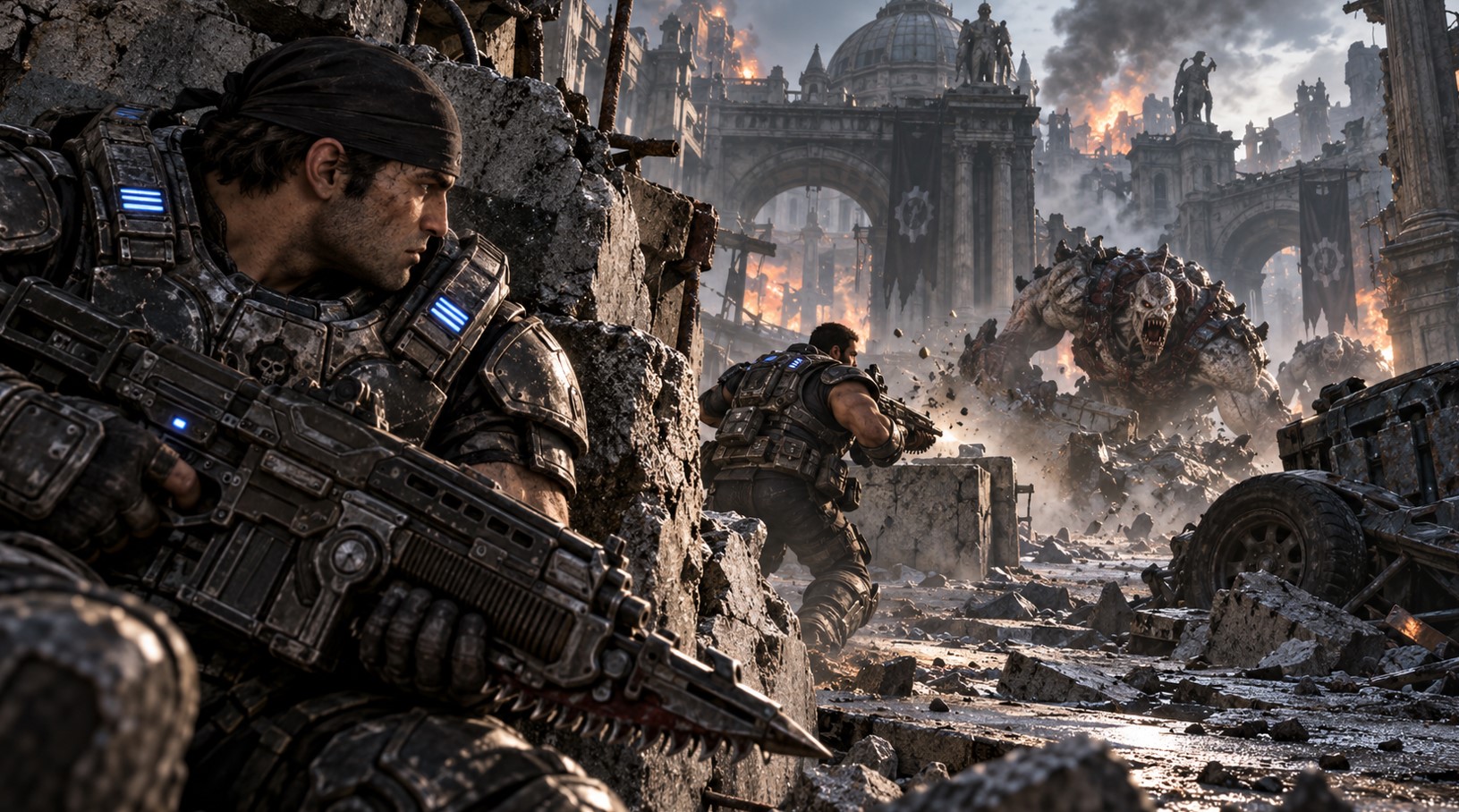
Reviewers consistently flagged the destruction as the thing that changes encounters most. A concrete barrier that soaked fire for a whole firefight in Gears 5 will visibly degrade here, and the Locust are smart enough to work on it while you’re pinned.
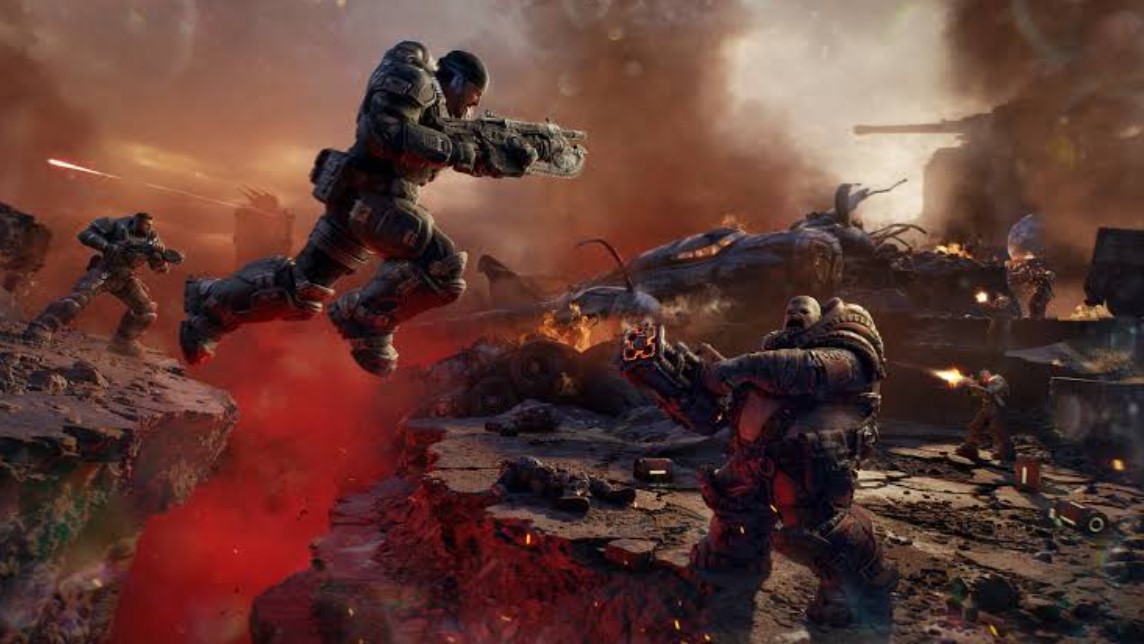
The habits that follow from that:
- Scout your next two positions before you need them – identify current cover, backup cover, and a route out, because you’re moving whether you planned to or not.
- Watch the cover, not just the health bar. Chunks coming off means your clock is running.
- Prone low-ground options are a real answer when a wall has been shot down to a stub rather than removed entirely.
- Don’t fight from a position you can’t leave – a corner with one exit becomes a coffin the moment the Locust start lobbing smoke.
- Let bad cover go early. Repositioning on your terms beats being forced out on theirs.
The Omen – the red skull that fills your screen as you take damage – now shows blood spray directionally, telling you where the hit came from. That’s a genuine tactical upgrade, not a cosmetic one. If the spray says your left, your cover isn’t covering your left anymore.
Gears of War: E-Day Tips for Reading the Rebuilt Locust
The enemy AI is the pillar nobody talks about enough, and it’s the one that’ll kill you most.
These Locust flank. They throw smoke grenades specifically to dislodge you. One reviewer called E-Day one of the more challenging shooters they’d played recently, and the difficulty isn’t bullet sponges – it’s that the opposition has a plan.
The roster is broader than Gears 5’s too. Armored Wretches, elite Drones, Tickers that detonate themselves, mini-boss Seeders, towering Reavers, and emergence holes that keep feeding the fight. Each wants a different answer.
A few reliable reads:
- Smoke means a flank is already moving. Don’t wait for the grenade to clear; pick a new angle immediately.
- Tickers need to die at range. Letting one close is a free knockdown at best.
- Emergence holes are the priority target when one opens mid-fight – grenades on the hole beat trading shots with what comes out.
- Armored Wretches reward precision over spray and will close distance faster than you expect.
- Reavers change the shape of an arena rather than just adding a health bar; find overhead cover before engaging.
The old Gears rhythm of sitting behind one wall and trading pot-shots until the room empties does not work here. The room comes to you.
Pillar Two: Movement With Weight
Sprinting, sliding, jumping, climbing and cover gaps all exist, and they’re all more committed than they used to be.
The design language The Coalition pushed was readable, weight-based movement. You can’t cancel out of things as freely, animations carry through, and the twitchy bounce meta that defined competitive Gears for years has been deliberately dulled.
That sounds like a restriction. In practice it’s a different skill: route planning instead of input mashing.
Movement advice that holds up:
- Move with purpose, not constantly. Sprinting into a sightline you haven’t checked is how most early deaths happen.
- Slides are for covering gaps between cover, not for dodging bullets mid-exchange.
- Climbing opens vertical routes the Locust won’t always track immediately – worth scouting.
- Commit to the roadie run when you start it, because stopping halfway leaves you exposed in the open for longer than the full dash would have.
This is also why the game ships with Boot Camp and Combat Training, and why skipping them is a mistake even for veterans. Especially for veterans. Fifteen minutes there rewrites habits that would otherwise cost you an hour of frustration on Act 1.
Pillar Three: Weapons That Behave Differently
Two changes here matter more than the new guns.
First, all projectiles now have simulated ballistics. They travel, they drop, they take time to arrive. Hitscan instincts carried over from older entries will make you miss at range until you adjust to leading your shots.
Second, the Gnasher went from eight shells to six, with a new active reload behaviour attached to it. For a weapon that’s been the series’ competitive backbone for two decades, that’s a significant trim. Two fewer shells means two fewer mistakes you can afford in a close-quarters duel.
Active reload itself is still the core rhythm, and it’s still where free damage lives. The sensible approach is to practise the timing during lulls rather than gambling on a perfect reload while something is charging you. A jammed weapon mid-push is worse than a slow one.
| Weapon | What It’s For | Notes |
|---|---|---|
| Lancer | General purpose | Chainsaw origin story is a campaign beat here |
| Gnasher | Close quarters | Six shells now, not eight – pick your fights |
| Gutpuncher | Grouped targets | Grenade launcher with manual detonation timing |
| Incinerator | Area denial | Acid shotgun, strong against clustered enemies |
| Hookshot variant | Repositioning and control | Situational but distinct |
The Gutpuncher’s manual detonation is the one worth practising. You’re not firing and forgetting – you’re placing a charge and picking the moment, which means it rewards reading enemy movement a second ahead.
There’s also a Supply Depot system for weapon modifications. Reviewers found it shallower than they’d hoped, but it exists and it’s free value, so stop in.
Oh, and shoulder swapping while aiming is in. If you’ve ever been annoyed about peeking left-hand cover with a right-shoulder camera, that’s fixed.
Pillar Four: Difficulty, and the Downs Counter
E-Day ships with extensive customizable difficulty options in the campaign, which is the most player-friendly thing about it.
The system worth understanding first is the Downs Counter – a visible tracker showing how many Down But Not Out lives you’ve got left. That turns a vague sense of “am I doing badly” into an actual number you can plan around.
How to read it in practice: if you’re burning downs on an early encounter in an act, the problem is usually positioning rather than aim. Drop difficulty or change approach before the counter forces the issue.
For co-op, which supports four players online and two in split-screen:
- Spread your targeting. Four players focusing one Drone wastes three players’ worth of pressure.
- Revives beat kills. A downed teammate is a damage loss and a liability; pick them up first.
- Call cover destruction. If your wall is going, say so before it goes.
- Assign the emergence holes to one player rather than everyone pivoting at once.
Horde Siege: Pick a Class and Actually Play It
The twelve-player mode splits you across three squads, each with its own objectives, before converging on extraction. Four classes are on offer.
| Class | Role | Play It If |
|---|---|---|
| Assault | Front-line damage and pressure | You want to hold ground and push |
| Breacher | Close-range aggression, opening spaces | You like the Gnasher and short sightlines |
| Marksman | Long-range elimination | You can hold an angle without wandering |
| Medic | Revives and squad sustain | You’d rather keep a squad alive than top the chart |
One caution worth being upfront about: Horde Siege and Versus Ranked weren’t available during the review embargo. Every published score you’ve seen covers the campaign only. So anything you read today about how good the multiplayer is – including guidance from me – is based on design descriptions rather than live play at scale. Give it a week before anyone can tell you what the meta looks like.
More Gears of War E-Day Tips Nobody Mentions
Smaller things that come up once the basics stick.
The campaign runs across three in-game days, starting with Emergence Day itself, and reviewers put its length in the neighbourhood of the 2006 original. It’s a tight, mostly linear run through Kalona City, with optional side missions along the way.
Those side missions are the one piece of consistent criticism. Reviewers found them repetitive with thin rewards, and GameSpot specifically flagged open-world segments as disrupting the campaign’s pacing. If you’re playing for the story, skipping most of them is defensible.
The gore system now does localized damage, which is cosmetic but also a feedback channel – you can read where your shots are landing on a Drone without checking a health bar.
And the technical side is doing real work. Unreal Engine 5 with Nanite geometry, ray-traced reflections and MegaLights for dynamic shadows. The Coalition’s claim of over 100 times the environment and character detail of Gears 5 is marketing arithmetic, but the audio and visual feedback genuinely help you read fights.
FAQ
When did Gears of War E-Day come out?
October 6, 2026 on Xbox Series X|S and PC, with Deluxe buyers getting five days of early access from October 1.
Is it on Game Pass?
Yes, day one.
How long is the campaign?
Roughly comparable to the 2006 original, spanning three in-game days.
What’s the biggest mechanical change?
Destructible cover that degrades during fights, paired with movement rebuilt to discourage the old wall-bouncing style.
Did the Gnasher change?
Yes. It dropped from eight shells to six and has a new active reload behaviour.
Does it have co-op?
Four-player online co-op and two-player split-screen on consoles, plus the twelve-player Horde Siege mode.
Is the multiplayer any good?
Nobody knows yet. Horde Siege and Versus Ranked were both missing from review builds, so published scores cover the campaign only.
Stop Bouncing. Start Moving.
The single sentence version of everything above: E-Day rewards players who treat a firefight as a problem of position rather than a test of reflexes.
Cover expires. The Locust flank on purpose. Your bullets travel. Your Gnasher holds two fewer shells than the one in your muscle memory. Every one of those changes points the same direction – toward thinking a beat ahead instead of reacting a beat late.
Veterans will find that frustrating for about an hour and then genuinely refreshing. Newcomers, oddly, may have the easier time, since there’s nothing to unlearn.
Run Boot Camp. Watch the walls. Lead your shots. And if the Omen tells you the blood came from your left, believe it and move.
If this saved you a few avoidable downs on your first act, send it round on X, Reddit or whichever squad chat is already arguing about the Gnasher nerf – small writing teams travel on word of mouth and nothing else. Bookmark it too, because Horde Siege and Ranked are still unmeasured and we’ll be updating this page rather than filing a fresh one once the meta settles. And if creative or commercial collaboration brought you here, write to the BandurArt team directly – no emergence hole required.