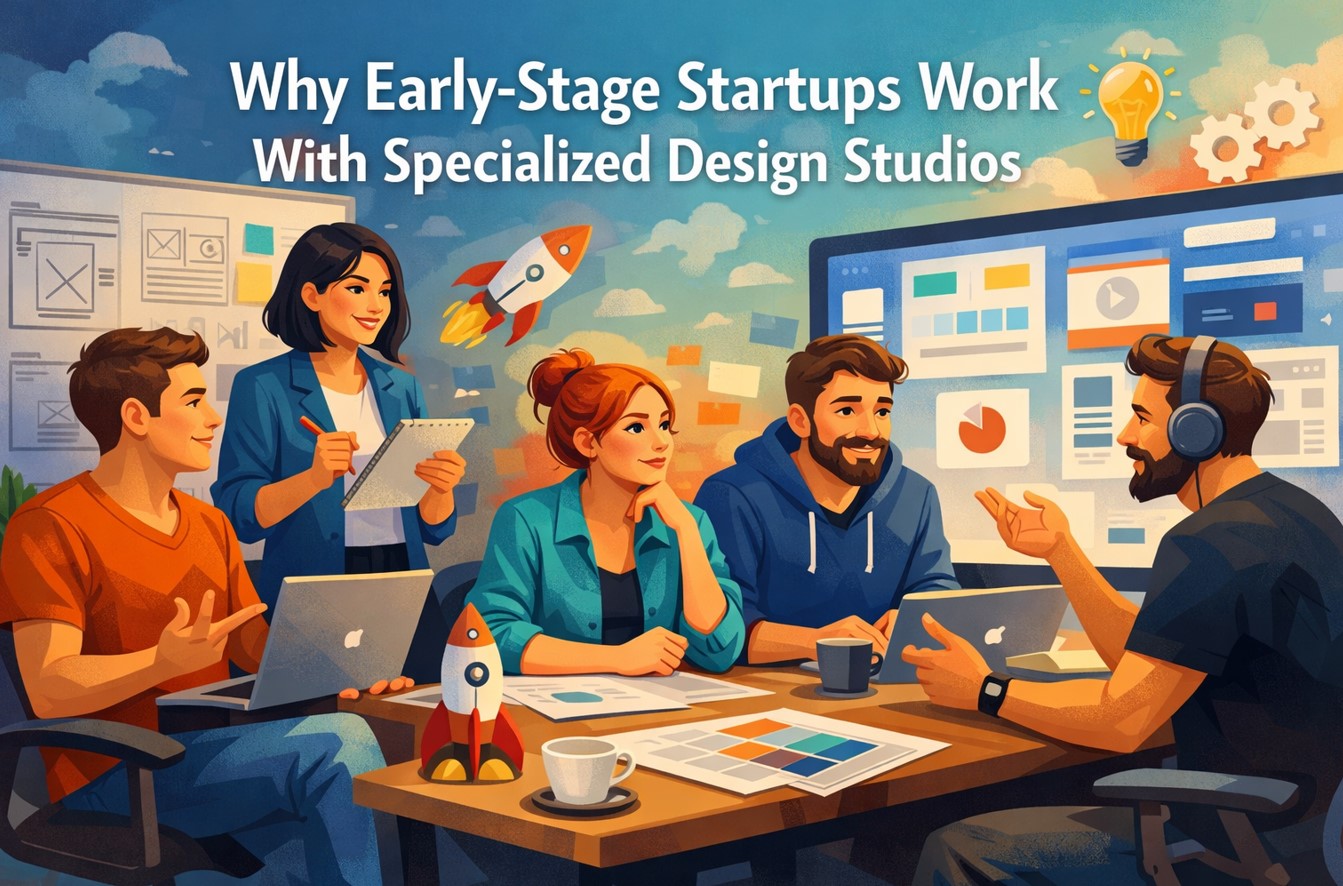
Early-Stage Startups Choose Specialized Design Studios and Here is Why
Early-stage startups face pressure to move fast while making the right product decisions. Limited budgets, small teams, and unclear requirements make execution challenging. Partnering with a design startups studio helps founders focus on building the right product without overextending internal resources. Specialized design studios bring structure and experience at a stage where startups need clarity more than scale. Their role is not only to design interfaces, but to guide early product decisions.
The problem is that many founders do not consider that it is not easy to transform a vision into a real product. They can end up designing features that are lacking in user requirements or business goals without sound design advice. Design studios are turned into strategic alliances and combine creative intelligence with business savvy. They steer startups out of traps that can befall them and accelerate time to market and safeguard initial user perception.
Collaborating with established design studios allows startups to have access to senior talent immediately, without necessarily paying full-time. Such adaptability is essential in cases where the runway is narrow, and all decisions should be able to create the greatest impact. The studios introduce proven structures and approaches that have been refined in dozens of projects. The startup will be able to access the collective knowledge in the industry rather than figuring out the correct path through trial and error.
Early-Stage Challenges That Design Studios Help Solve
Founders tend to do product vision, fundraising, and customer discovery simultaneously. Such juggling may discontinue or postpone design work, resulting in inconsistent user experience and slow validation. Design studios assist startups to get through these pitfalls by providing specialized knowledge. They bring transparent procedures and priorities, which are also effective during the formation of internal teams.
Lack of committed design leadership at early-stage startups creates bottlenecks in the entire product development cycle. Decision-making, ad-hoc, or assigning designers’ work to developers who have not been trained in UX tends to produce products that are technically sound but not friendly to users. Design studios bridge this divide by creating design operations at the outset and making sure that user research, visual design, and interaction design are all advanced concurrently.
The other similar issue is maintaining design consistency between features and platforms. The speed of iteration can result in detached experiences, which can be confusing to the end user. As the product develops, studios establish governance mechanisms and documents to ensure cohesion. This is particularly essential when trying to present investor demos or even launching a beta, because first impressions may make or break a future success.
Speed Without Sacrificing Product Quality
Speed is important when launching a product, but there is a risk of causing a long-term issue when rushing the design. Extraordinary design studios balance speed and considered UX:
- Fast prototyping of concepts using low-fidelity prototypes.
- Simple user flows that enable early adoption.
- Architectures capable of responding to the expansion of the product.
This solution allows new businesses to be released fast without having to create usability debt that will cost to remediate down the line.

Design studios apply effective procedures to shorten schedules, design sprints, and iterative testing. They understand where and why to make the tradeoffs. As an example, they use component libraries and templates to accelerate visual design, and spend more time in user research and information architecture, which is the key to product success.
Quick trade-offs are also essential to moving fast. Established studios assist startups in prioritising the most important users and features in such a way that the design work has the most significant impact. This prevents the usual pitfall of attempting to cater to all use cases at the very beginning, watering down the product, and wasting resources. A narrow scope at first, then grow strategically, and market fit will come sooner.
Access to Cross-Functional Product Expertise
Several startups and industries get the professional services of specialized design studios. This experience allows them to identify pitfalls before they occur and understand the impact of design decisions on development, onboarding, and retention. This advice is particularly useful to founders who have no significant experience with products. It eliminates guesswork and increases confidence in early decisions.
Design studios introduce pattern recognition to the solution of similar problems in different settings. They understand what onboarding flows work best, what navigation patterns can help to minimize friction and what visual treatment can be used to create trust. This experience is invaluable to startups that are unable to conduct large-scale A/B tests or experiment with many failed strategies.
In addition to pure design skills, more specialized studios tend to have strategists, researchers, and product managers. Their recommendations cover wider business considerations like pricing model, feature priority, and go-to-market strategy in their application to user experience. This integrated approach makes sure that design choices are in alignment with business goals, as opposed to existing as islands.
Supporting Investor and Customer Communication
A well-designed start-up would aid in communicating value to investors and early customers. Prototypes and well-designed interfaces transform abstract concepts into concrete solutions and match the expectations during demos and pitches. Design studios contribute to this achievement by creating assets that effectively and consistently define the value of a product.
When making a pitch to investors, the founders must demonstrate a believable execution trajectory, rather than an idea. Professionalism and preparedness. High-fidelity prototypes and polished design indicate that the team knows customers and can provide a market-ready product. The studios assist in generating pitch decks, demo environments, and marketing materials that work together to narrate a visual story.
In the case of customer-facing communication, design studios ensure that early adopters (users or investors can understand the value of a product immediately. They design onboarding experiences, which reduce time-to-value and achieve aha moments that increase retention. A combination of clear visual hierarchy, intuitive interactions, and supportive microcopy makes the experience so that it turns the users of the trial into fans.
Building a Foundation for Scale
The decisions made in the early design determine the ease of product development. The bad UX decisions cause friction to the additions of new features. Even the MVP is used to build the best studios with future expansion in mind.
A strong base eliminates redundancy and enables startups to transition without much difficulty as the teams and demands evolve.
Scalable design begins with the correct architecture and component systems. Modular design languages created by studios allow it to add new features without redesigning. They also record principles and patterns that the internal team can use again as the company expands and acquires design in-house.
Scaling planning implies the consideration of technical limitations and opportunities. Knowledge of product development Studios that are knowledgeable of the impact of design on engineering complexity, performance, and maintainability. They collaborate with developers to ensure that designs are ambitious but feasible, and thus beautiful mockups are not left becoming impossible to construct.
FAQ
What do you normally pay to hire professional design studios?
The price is given based on scope and reputation. Startups in the initial stages should anticipate up to 30,000-150,000 to design small-scale products. A variety of studios have fixed-price work, monthly retainer, or equity partnerships to meet startup budgets.
What is the average length of a design engagement in an early-stage startup?
The first interactions take 8-12 weeks, which include user research, UX design, visual design and prototyping. Other startups have 2-4 week sprints to validate ideas prior to full design. Continued efforts tend to be of lower hours as the internal workforce increases.
To hire an in-house designer or outsource to design studios?
In the case of pre-seed or seed companies, a studio offers a higher value using senior expertise and quicker implementation. After you get to Series A, it is cheaper to have in-house staff. Most startups begin with studios and then develop in-house teams, maintaining studios to do special projects or overflow.
What do we want when we choose a design studio?
Focus on studios that have industry or product experience. Examine portfolios, not merely look at visual polish. Enquire about process, feedback management, and whether they offer design systems and documentation. References by the founder are priceless.
Is it possible to use design studios to conduct user research and validation?
Yes. User research is a service offered in the majority of studios: interviews, usability testing, competitive analysis, and validation studies. Their studies accelerate the knowledge and prevent the construction of the undesired features. Research panels and methods in studios can also result in faster data than would be possible with a start-up alone.
What do we expect to receive as deliverables of a design studio engagement?
Common outputs include research results, wireframes, high-fidelity mockups, interactive prototypes, design-system documentation and dev-ready asset files. Many design studios also provide developer specifications, onboarding flow documentation, and style guides. These are things that you need to clarify at the beginning, in line with the needs of your technical team.
What do design studios do with our current development team?
Good design studios work in close collaboration during the design process. They participate in planning sessions, give specifications, and remain accessible during implementation to clarify questions and perform reviews. The most successful studios know the technical constraints and create new designs in a way that does not create friction between design and engineering.
Conclusion
Startups at the early stage collaborate with design studios that specialize in reducing risk, getting to market quicker, and designing products that people understand. Through combining velocity and disciplined UX, studios assist founders to transform initial ideas into products (games included) that have sustainable potential.
P.S. You can support the design studio of BandurArt by sharing this post and adding it to your bookmarks. Make sure send us a message directly if you want to collaborate.