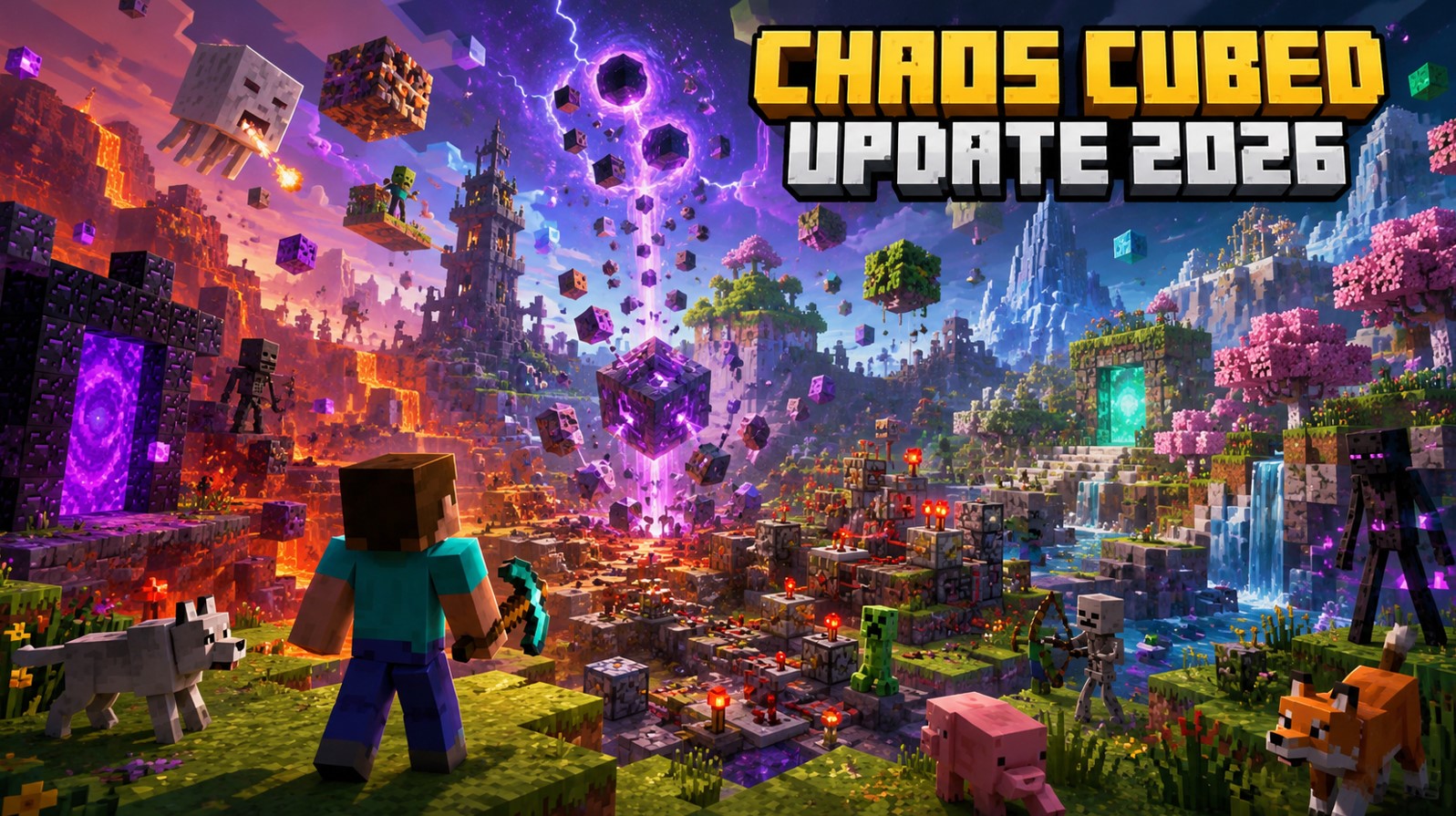
Minecraft Chaos Cubed Update is Here!
So Mojang went and did the thing again. Just when you thought your cave-diving routine was settled – mine some diamonds, dodge a creeper, go home – they drop a biome that looks like Yellowstone threw a tantrum. Bubbling pools, gas you can actually smell through the screen (okay, not really, but you get it), and a little jumping cube that eats your building blocks and turns into a bouncy menace. That’s the gist of the new drop – Minecraft Chaos Cubed. And honestly? It’s one of the more playful updates we’ve gotten in a while.
Let me walk you through everything that landed, what’s worth your time, and the couple of things hiding under the hood that nobody on launch day was talking about. Grab a snack. This one’s got layers.
Minecraft Chaos Cubed Is Mojang’s Weirdest Drop Yet
Here’s the quick version. Chaos Cubed went live on June 16, 2026, as Java Edition 26.2 and Bedrock Edition 26.30. It rolled out at the same time on every platform, which is the standard now. The headline act is a brand-new underground biome – the sulfur caves – and the mob that lives there, the sulfur cube.
But calling it “a biome and a mob” undersells it. This drop is really about one idea: what happens when you feed a creature a block and watch physics take the wheel? That’s the whole pitch. Mojang basically built a physics toy and stuffed it into a cave.
It was announced back at Minecraft LIVE in March 2026, and the snapshot cycle ran for about six weeks before the full release. If you were on the snapshots, you already know the chaos. If not, well – welcome.
A couple of things to set the stage:
- This is the second of three planned drops for 2026. Earlier this year we got Tiny Takeover, the one with baby mobs and the golden dandelion. The next one, Dappled Forest, lands in the fall.
- The block-eating trick on the sulfur cube is Java-exclusive for now. Bedrock players still get the mob and the biome, but the absorb mechanic isn’t there in the same way yet.
So yeah. Big drop. Let’s get into the good stuff.
How to Find Sulfur Caves in Minecraft Chaos Cubed?
You don’t just stumble into a sulfur cave by digging straight down and hoping. There’s a tell. Up on the Overworld surface, you’ll spot sulfur springs – small bubbling pools ringed with yellow sulfur and red cinnabar blocks, with a faint haze of gas drifting off the water. Think of them as a neon sign pointing down.
See one? Start digging beneath it. The springs act as surface markers for the cave system below. It’s a neat bit of design, actually. Instead of making you wander blind, the game leaves breadcrumbs. You just have to know what you’re looking at.
Now and then – and this is rare – a sulfur cave will poke up onto the surface and form what players have been calling sulfur “lands.” Mojang said they leaned into that rather than blocking it, wanting it to feel like a lucky find. So if you ever crest a hill and see a patch of yellow rock where green grass should be, congrats. You got the rare roll.
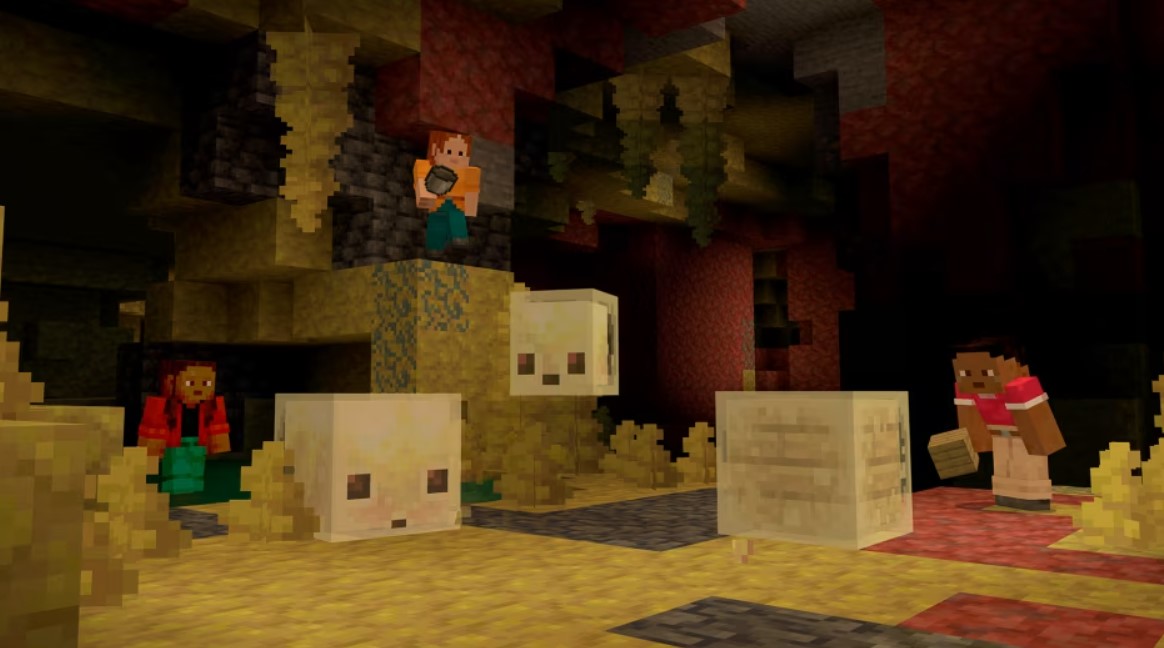
Once you’re down there, the place is unmistakable. Yellow-streaked walls, deep red cinnabar deposits, shallow water pools dotted with glow lichen, and sharp sulfur spikes poking out of the rock. It genuinely doesn’t look like anything else in the game. Less “spooky deep dark,” more “active geothermal field.”
One heads-up before you go spelunking: cave spiders now spawn naturally in sulfur caves. That’s a first. Outside of spawners and trial chambers, you’ve never run into wild cave spiders before. So pack milk for the poison, yeah?
Watch Out for Potent Sulfur and the Nausea Gas?
Here’s where the biome bites back. Those pretty bubbling pools? Underneath the water sits a block called potent sulfur, and it pumps out a cloud of noxious gas at the surface. Step into water that’s near or touching that gas, and you catch the Nausea effect. Your screen does the queasy wobble, and suddenly casually walking away is a lot harder than you planned.
You can craft potent sulfur yourself from nine sulfur blocks, which opens up some fun building options. Want a bubbling hot spring in your base? Drop potent sulfur under a pool of water and you’ve got one – bubbles, gas, the works. Just maybe don’t put it next to the bedroom.
The sulfur spikes are gentler than they look. Stepping on them won’t hurt you, unlike pointed dripstone. The only catch is they can occasionally break loose and fall, and a falling spike will damage whatever it lands on. So it’s not zero risk, but it’s close.
Meet the Sulfur Cube, Your New Chaotic Roommate
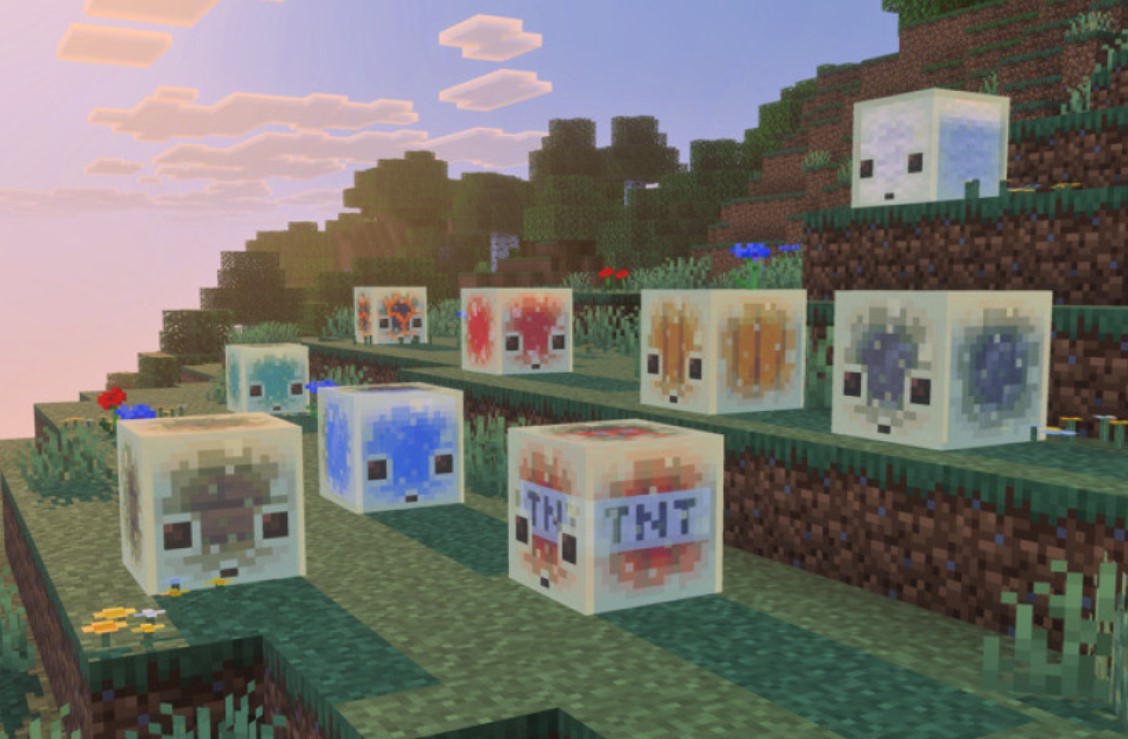
Okay, the star of the show. The sulfur cube is a passive, slime-like mob that hops around the caves doing absolutely nothing useful. It looks harmless. It mostly is. And then you feed it a block and everything changes.
When a large sulfur cube takes damage and dies, it splits into two small ones, exactly like a slime or magma cube. Here’s the twist, though: the small ones can grow back into large ones over time – about 20 minutes – and you can speed that up by feeding them slimeballs. Want to stop the growth? Feed it a golden dandelion (the same item from the Tiny Takeover drop) and it stays small. Baby-mob logic, basically.
You can also scoop a large cube into an empty bucket and carry it home. Bucket of sulfur cube. I love that this exists. No more herding the thing across your base by feeding it blocks one at a time – just bucket it and go. If you named the cube first, the bucket keeps the name. Small touches like that are why people stick around for these drops.
But the magic – the actual reason this mob is special – is the absorb mechanic. Drop a block near a cube, or hold a block and interact with it, and the cube swallows it whole. Once it’s got a block inside, it stops moving on its own and turns into a physical object. You can punch it, push it, launch it, bounce it. And which block it ate decides exactly how it behaves.
This is where it gets nerdy, in the best way.
How the Sulfur Cube Archetypes Work in Minecraft Chaos Cubed?
Each block falls into an archetype, and each archetype sets the cube’s speed, bounciness, ground friction, air drag, and whether it floats or sinks. Mojang described them mostly in sports terms, which makes them way easier to remember.
| Archetype | Vibe | Speed | Bounce | Example Block | Floats? |
|---|---|---|---|---|---|
| Football / Regular | Balanced all-rounder | Medium | Medium | Grass block | Yes |
| Rubber ball / Bouncy | Springy and fast | Fast | High | Oak log (wood) | Yes |
| Golf ball / Fast flat | Quick, low hops | Fast | Low | Moss block | Sinks |
| Hockey puck / Fast sliding | Slides forever | Fast | None | Blue ice | Sinks |
| Sticky | Stops on a dime | Slow | None | Sticky-type blocks | Sinks |
| Magma | Hot and risky | Medium | Medium | Magma block | Sinks |
Wood blocks make it bouncy and fast – perfect if you’re racing a friend in some makeshift Minecraft golf course. The magma cube doesn’t catch fire, but it’ll singe you if you get too close, especially when you’re already low on hearts. One game artist compared feeding it magma to their “put Sriracha on everything” phase, which, fair.
And then there’s the one everyone actually talks about.
Feed a sulfur cube TNT and it becomes a walking bomb. You still have to ignite it with fire or redstone, but unlike regular TNT, this thing can move while primed. The fuse runs about six seconds when lit normally. Prime it with a nearby explosion instead, and the fuse shortens to a random window between 0.75 and three seconds – which means chain reactions are now a real, working contraption. People had TNT-cube cannons going in snapshot footage before the update even officially shipped. Pulling off the explosive cube also earns you the cheeky “Uh Oh” advancement.
Quick rundown of the standout blocks to try feeding it:
- Wood – turns it into a fast, bouncy little rocket. Great for races.
- Magma – adds heat and danger; handy for a chaotic game of hot potato with friends.
- TNT – explosive, mobile, and the closest thing to a sentient creeper you’ll ever build.
- Blue ice – frictionless slider that won’t stop until it hits a wall.
One more thing worth knowing: while a cube has a block inside, it won’t take fall damage or most other damage. Attacks just knock it back, with stronger hits sending it flying further. Want the block out? Shear it. That removes the block, drops it, and switches the cube’s AI back on. So it’s fully reversible – experiment all you want.
Geysers Turn the Caves Into a Launchpad
Geysers might be my sleeper favorite. They’re a vertical-movement tool you build yourself, and they’re genuinely fun to mess with.
The recipe is simple. Put potent sulfur underneath one to four water source blocks, with a magma block sitting beneath the potent sulfur. That setup erupts at random intervals, blasting entities skyward with a burst of water particles. Swap the magma for a lava source and it triggers continuously instead.
What do you do with that? Whatever you want, honestly. Fast travel up a shaft. A trap for unsuspecting visitors. A multiplayer challenge where the whole point is launching your buddies across the base. The phrase floating around the community is something like “why is my friend flying across the room,” and yeah, that tracks.
It’s the kind of mechanic that looks small in patch notes and then quietly becomes a staple of every server minigame for the next year.
Cinnabar and Sulfur Give Builders New Paint
Builders, this one’s for you. The drop adds two full block families: sulfur (bright yellow) and cinnabar (deep red). And I mean full families – slabs, stairs, walls, polished versions, bricks, chiseled forms, the whole spread.
That’s a big deal because Minecraft’s underground palette has always leaned gray and beige. Suddenly you’ve got rich reds and warm yellows to work with, and they’re not some rare grind – they generate all over the sulfur caves. Want a temple that actually looks like it belongs in a volcanic region? Now you can build one without resorting to terracotta gymnastics.
The new sulfur spikes also grow naturally on these blocks, which gives the caves their jagged, almost coral-reef silhouette. It’s a strong look. Very screenshot-friendly, if that’s your thing.
The Bounce Disc and Six New Tracks
Music heads, you’re eating well. Chaos Cubed adds a new music disc called “Bounce,” and you find it tucked inside minecart chests in abandoned mineshafts – but only the mineshafts that generate inside sulfur caves. So if you’re already down there poking around, keep an eye out for rails crossing the biome.
On top of the disc, there are five new ambient exploration tracks composed by fingerspit: “Memories,” “Ebb,” “Home,” “Shores,” and “Nightly.” These play in the background while you wander, and they go a long way toward making the caves feel like their own place rather than a reskin. Good ambient music is one of those things you don’t notice until it’s doing its job perfectly.
What’s Quietly Happening Under the Hood
Here’s the part that didn’t make the splashy trailers but matters a ton, especially if you play Java or run a server.
For 17 years – since 2009 – Java Edition has rendered on OpenGL. That’s an aging graphics API, and hardware vendors have been backing away from it for a while. Chaos Cubed ships an experimental, opt-in Vulkan renderer that you toggle in the video settings. The F3 debug screen tells you which backend is active.
Why care? Vulkan gives the game lower-level, more direct control over your GPU, and it can run rendering on its own thread instead of choking the main game loop. For anyone whose frame rate tanks during chunk loading or in mob-heavy areas, this is the architectural fix that’s been a long time coming. It’s also the first real step toward bringing Vibrant Visuals – the fancy lighting and shadow system – to Java Edition. Older hardware that doesn’t support Vulkan just falls back to OpenGL, so nobody gets left behind.
A few other behind-the-scenes changes worth flagging:
- Hardcore got a fix. There was a long-standing loophole where players sidestepped permadeath through the Open to LAN feature. That’s closed now. A completed Hardcore run finally means what it’s supposed to mean. The community split on this one – purists cheered, and creators who built “100 days” series around the safety net are rethinking their format.
- A new /unpublish command. It closes an Open to LAN session without forcing you to quit the world. Small, but handy.
- Parties on Bedrock. Now in beta on Xbox, PlayStation, and Windows PC, you can group up with as many as 14 people, hop between worlds and Realms together, and chat in a private space. This actually arrived in 26.20 but it’s getting its proper spotlight now.
Here’s a tidy side-by-side of what landed where:
| Feature | Java Edition 26.2 | Bedrock Edition 26.30 |
|---|---|---|
| Sulfur caves & sulfur cube | Yes | Yes |
| Block-absorbing mechanic | Yes | Not yet |
| Cinnabar & sulfur block sets | Yes | Yes |
| Geysers | Yes | Yes |
| Bounce disc & ambient tracks | Yes | Yes |
| Experimental Vulkan renderer | Yes | N/A |
| Parties (group play) | N/A | Beta |
| Hardcore LAN exploit fix | Yes | N/A |
Different editions, different priorities. But the core sulfur-cube fun is there for everybody.
The Community Reaction and the Chaos Sparks Challenge
So how’s it landing? Pretty warmly, from what I’ve seen. The sulfur cube hit a sweet spot – it’s silly enough to make for great clips, but systemic enough that the redstone and server crowd are already building wild stuff with it. TNT-cube cannons, geyser obstacle courses, you name it. That’s usually the sign of a good Minecraft mob: people start using it for things Mojang never explicitly planned.
Mojang’s also running a community event called Chaos Sparks to ride the momentum. One of the challenges, dubbed “Rancher,” asks the whole player base to collectively spawn 50 million sulfur cubes. Hit the goal and everyone gets a free add-on – Chaos Cubed: Cursed Cubes from Blockception – plus a handful of Character Creator items. It’s a fun way to keep the servers buzzing in the first few weeks, which is exactly when communities are at their liveliest.
If you run a server, a word of caution that floated around the host community: decide your TNT-cube policy early. Explosive cubes are basically the new creeper for griefing potential. Got a no-grief rule? Figure out whether you’re banning them, fencing them into certain zones, or just letting players learn the hard way. And expect the usual week or two of plugin wobble while Paper, Spigot, Fabric, and Forge catch up to the new version. Standard launch-week stuff, but worth planning for.
What’s Coming After This Drop?
Chaos Cubed is the middle child of 2026. Tiny Takeover came first. Next up, this fall, is Dappled Forest – an autumn-themed update bringing forests full of orange, red, and yellow foliage plus new wood types. So if the warm tones of the sulfur caves got you in the mood for cozy builds, you won’t have to wait long for a whole biome built around that vibe.
There’s also the Switch 2 version of Minecraft arriving later this year, which will bring the Vibrant Visuals glow-up to that hardware and let you carry over your existing Switch worlds. Updates always push to every platform at once, so Switch players aren’t missing out on Chaos Cubed in the meantime.
Is Minecraft Chaos Cubed Worth Playing Right Now?
Short answer? Yeah, especially if you’ve felt a little bored with your usual loop.
Here’s my honest read. If you’re a builder, the cinnabar and sulfur block sets alone justify a download – that’s a genuinely fresh palette in a game that doesn’t add color families often. If you love systems and tinkering, the sulfur cube is a sandbox inside a sandbox; you’ll lose an evening just figuring out which block combos do what. And if you’re on Java with a beefy-ish GPU, flipping on the Vulkan renderer might be the smoothest your game has run in years.
The flip side: Bedrock players don’t get the full absorb mechanic yet, which is the most interesting part. So if that’s your edition, temper expectations a touch. The biome and the mob are still there, just not the deep experimentation.
But broadly? It’s a confident, playful drop that knows exactly what it wants to be. Not every update needs to reshape the whole game. Sometimes a weird bouncing cube that eats your TNT is enough. And this time, it kind of is.
FAQ
What is Minecraft Chaos Cubed?
It’s Mojang’s June 16, 2026 game drop – Java 26.2 and Bedrock 26.30 – adding sulfur caves, the sulfur cube mob, new cinnabar and sulfur blocks, geysers, and a music disc called Bounce.
How do I find sulfur caves?
Look for sulfur springs on the Overworld surface – small bubbling pools edged with yellow and red blocks and a haze of gas. Dig down beneath one and you’ll reach the cave biome.
What does the sulfur cube do?
It’s a passive mob that swallows blocks and changes its physical behavior based on what it ate – bouncing, sliding, sticking, or even exploding if you feed it TNT.
Can you put a sulfur cube in a bucket?
Yep. Scoop a large cube with an empty bucket to carry it home. If you named it first, the bucket keeps the name, and the tooltip shows any block it’s holding.
Is the block-eating mechanic on Bedrock?
Not yet. As of this drop, the absorb mechanic is Java-exclusive. Bedrock still gets the sulfur cube mob and the cave biome, just without the full block-swallowing trick.
What is the Vulkan renderer in Chaos Cubed?
It’s an experimental, opt-in graphics backend for Java Edition that you toggle in video settings. It can boost performance and is the first step toward Vibrant Visuals on Java.
Does Chaos Cubed change Hardcore mode?
It does. The update permanently closes the Open to LAN loophole that let players dodge permadeath, so Hardcore now plays the way it was originally designed.
Final Thoughts
Chaos Cubed isn’t trying to be the biggest update ever. It’s trying to be fun, and it nails that. A cave biome that finally breaks the gray-stone monotony, a mob that turns block-feeding into a physics playground, and a quiet engine overhaul that sets up the next several years of Java Edition – that’s a strong package any way you slice it.
So go find a sulfur spring. Dig down. Feed a cube some TNT and stand a little too close. Worst case, you respawn with a story. Best case, you build the next viral geyser course and somebody clips it.
Either way, the chaos is waiting. Have fun down there.
Fuel our artistic journey by sharing this post across your social media channels and adding it to your bookmarks! Your online support helps BandurArt grow, but we are also thrilled to connect beyond the screen. Please write to our team directly if you are eager to embark on a unique creative or commercial collaboration together.