
How to Use Steam Points: The Two-Minute Version
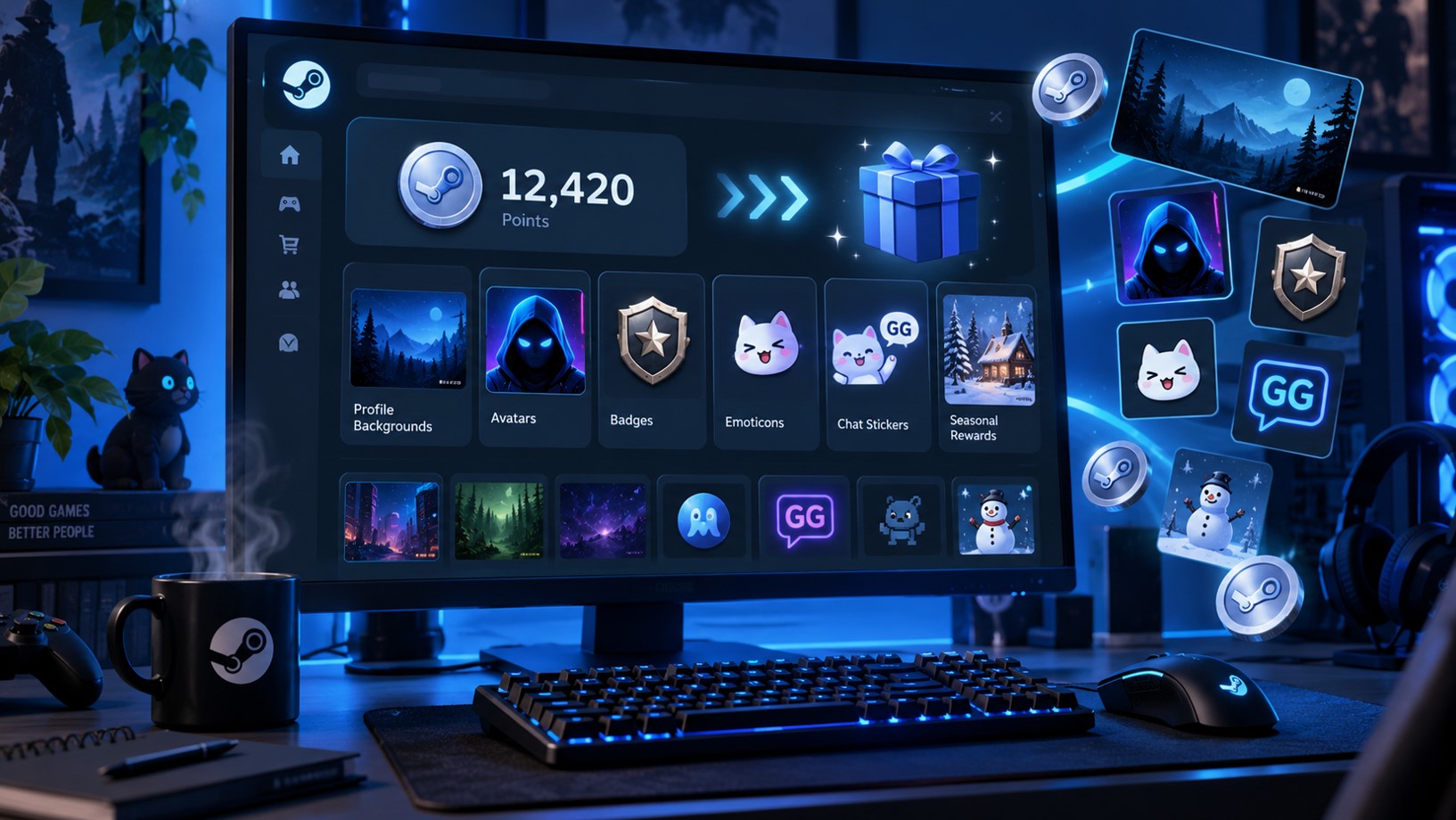
Somewhere on your account right now, there’s a number you’ve probably never looked at. Mine sat untouched for about three years before I realized I’d accumulated enough to redecorate my profile eleven times over. Steam Points are a loyalty currency. You earn them by spending money on Steam; they pile up silently, and they buy exactly one category of thing: cosmetics. Profile decoration, chat toys, Steam Deck personalization. That’s the whole scope.
Getting to them is simple. Open Steam in the desktop client or a browser, go to Store, then Points Shop. Your balance sits at the top right. Pick a category, pick an item, redeem.
The interesting question isn’t where – it’s what, because the Points Shop is one of the few storefronts where the pricing is flat per category rather than per item, which creates some genuinely lopsided value. A thirty-second decision can cost you the same as something you’d actually look at every day.
| Steam Points Can Buy | Steam Points Cannot Buy |
|---|---|
| Animated and static avatars | Games or DLC |
| Avatar frames | Steam Wallet credit |
| Profile and mini-profile backgrounds | Gift cards or cash |
| Emoticons and animated stickers | Community Market items |
| Chat effects | Anything tradeable |
| Steam Deck keyboard themes | Real-world value of any kind |
| Steam Deck startup movies | Refunds or conversions |
| Community Awards to give others | A reputation, sadly |
One important structural detail: Points Shop items can’t be traded or sold. This distinguishes them from the backgrounds and emoticons you get from crafting trading card badges, which are marketable. Once a Points Shop item is on your account, it’s yours permanently, and it’s going nowhere. You can equip, unequip, and swap freely, but you can’t pass it on.
How to Use Steam Points Without Wasting Them on Day One
Before spending anything, understand where the balance comes from, because that changed dramatically this year.
The core earn rate is 100 points per $1.00 spent on Steam store content – games, DLC, soundtracks, hardware, in-game items, applications. Regional pricing scales it accordingly. Buy a $60 game, get roughly 6,000 points.
That used to be one of two income streams. The other was Community Awards: when someone gave you an award on a review, guide, screenshot or workshop item, you received a slice of points a couple of weeks later.
That stream is dead. On January 14, 2026, Valve launched the Second Edition of Steam Community Awards and removed point transfers entirely. Valve’s own reasoning was that the tipping mechanic rewarded a narrow band of attention-grabbing content rather than thoughtful contributions. Awards issued before the change still paid out their pending transfers, but nothing since has.
The same overhaul cut the award roster down to twelve designs, all priced identically at 500 points, and retired the infamous Jester – the clown icon people mass-awarded as a badge of dishonour. That one change ended an entire cottage industry of award farming.
So the honest 2026 answer: the only reliable way to earn Steam Points is to spend money on Steam. Anyone telling you there’s a grind, a task list or an achievement route is working from an outdated guide.
Two practical consequences. First, big-ticket purchases matter – hardware counts, so buying a Steam Deck drops a very large balance into your account. Second, refunding a purchase reverses the points it generated, so don’t plan a shopping spree on points from a game you’re still deciding about.
The Price List Worth Memorizing
Here’s the part that makes strategy possible. Pricing in the Points Shop is largely fixed by category rather than set per item, so an animated avatar from a tiny indie costs the same as one from a blockbuster.
| Category | Typical Cost | Notes |
|---|---|---|
| Emoticons | 100 | Cheapest thing in the shop |
| Static profile backgrounds | 500 | Good filler at low balances |
| Community Awards (to give) | 500 each | All Second Edition awards cost the same now |
| Animated stickers | 1,000 | Chat-only, seen by few people |
| Avatar frames | 2,000 | Static versions sometimes cheaper |
| Animated profile backgrounds | 2,000 | High visual impact per point |
| Animated avatars | 3,000 | The flagship purchase |
| Bundles | Up to 10,000+ | Fixed contents, rarely good value |
Treat those as the standard tiers rather than gospel – Valve adjusts things and seasonal items sometimes sit outside the pattern. But the shape holds, and it tells you something immediately: an animated background costs the same as an avatar frame, and both cost two-thirds of an animated avatar.
If You Have Under 1,000 Points
You’re in filler territory, and that’s fine. Don’t save up out of principle.
A static profile background at 500 points is the single best low-balance purchase, because it’s the largest visible surface on your profile page and it changes the whole impression of the account. Two emoticons at 100 apiece round out the rest.
What to skip at this level: anything chat-based. Animated stickers at 1,000 are out of reach anyway, and emoticons are cheap enough that buying a handful costs you nothing meaningful.
One more move worth making before you spend anything – check whether there’s an active Steam event. During festivals and seasonal sales, Valve regularly parks free Points Shop items on the event page, redeemable at zero cost. Past examples include anniversary backgrounds and animated stickers, and genre festivals routinely bundle a free avatar, frame and sticker together. If a free frame is sitting there, don’t spend 2,000 on one.
If You Have 1,000 to 5,000 Points
Now you’re making a real decision, and it comes down to one question: who actually sees this?
Your profile page gets visited by people considering a friend request, checking your reviews, or scrolling a game’s community hub. Your chat effects and stickers get seen by the handful of friends in your Steam chat, most of whom are on Discord anyway.
Given that, the efficient allocation at this level is an animated profile background at 2,000 plus an avatar frame at 2,000, and skip animated stickers entirely. Both of those changes register instantly on a profile visit. Animated stickers cost half as much and reach a fraction of the audience.
If you’d rather concentrate, a single animated avatar at 3,000 is the highest-impact single item in the shop. It’s the one thing that shows up next to your name everywhere on Steam – comments, friend lists, discussions, reviews – rather than only on your profile page.
That’s the genuine trade. One thing visible everywhere, or two things visible in one place.
How to Use Steam Points on a Steam Deck?
Deck owners have two exclusive categories that a lot of desktop-only players don’t realize exist.
Keyboard themes replace the on-screen keyboard’s appearance with game-themed designs. Low stakes, purely aesthetic, but you look at that keyboard constantly.
Startup movies are the better buy. These are short video clips – Valve’s guidelines put them at three to ten seconds with audio – that play when the Deck boots. They’re built at 1920×1200 to fill the Deck’s screen, and they also appear in Big Picture mode on a desktop, cropped to standard widescreen. Many of them incorporate the Deck’s silhouette into the animation.
That Big Picture detail is the useful bit: a startup movie isn’t wasted money if you also play on a TV or a couch setup. It’s one of the few Points Shop categories that does something beyond decorating a page.
Both categories are managed in Steam’s settings once redeemed, so you can swap between everything you own freely.
If You Have 5,000 to 20,000 Points
At this level you can afford everything you actually want, which means the risk shifts from scarcity to waste.
Build a coherent look rather than collecting. An animated avatar, a matching frame, a background from the same game and a mini-profile background that doesn’t clash will look dramatically better than four expensive items from four unrelated titles. The Points Shop lets you filter by game specifically because themed sets work.
This is also the range where bundles start tempting people, and where I’d push back hardest. Bundles package a fixed set – typically an animated avatar, frame, mini-profile and background from one game – at a price around 10,000. The maths rarely favours you. For the same points you could hand-pick three animated avatars and several frames of your own preference across different games. Bundles make sense only when you genuinely want every single piece, and that’s rarer than the presentation suggests.
If You’re Sitting on 100,000 or More
They exist. Long-time buyers, Steam Deck owners, people who’ve been on the platform since the Orange Box.
Honest advice: there’s nothing to save for. Points don’t appreciate, don’t expire in any practical sense, and can’t be converted to anything. A hoarded balance is doing precisely nothing.
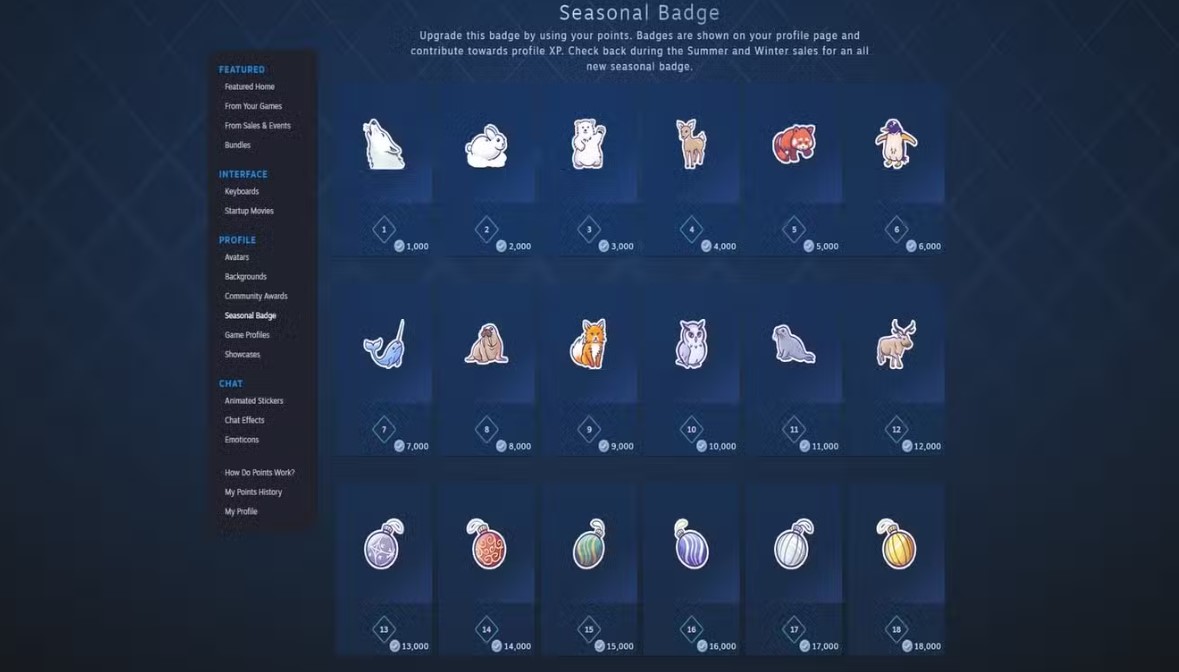
Two reasonable outlets. First, Community Awards at 500 each – they no longer pay the recipient anything, but they still signal appreciation on a guide or review that genuinely helped you, and it costs you a currency you can’t otherwise spend. Second, rotate your profile seasonally. Buy a winter set in December and a different one in summer. It’s the only way a large balance produces ongoing value.
What you shouldn’t do is anything involving a third-party site offering to sell you points. Steam doesn’t sell points directly, points have no monetary value, and accounts that get involved in workarounds tend to have a bad time.
Value Traps Worth Avoiding
- Bundles – almost always more expensive than picking the same pieces individually.
- Chat effects – widely regarded as the weakest category in the shop for what they cost.
- Animated stickers at 1,000 when a 2,000 background reaches ten times the audience.
- Buying an item during an event that the event page is handing out free two clicks away.
- Hoarding for a future sale – the Points Shop doesn’t discount.
Free Items You Should Be Claiming
- Seasonal sale pages frequently include free Points Shop items alongside the discounts.
- Genre festivals – 4X, horror, strategy and similar events regularly offer a free avatar, frame and sticker set.
- Anniversary events have historically included free profile backgrounds and animated stickers.
- These are time-limited and vanish when the event closes, so claim first and decide later.
- Claiming costs nothing and the item stays on your account permanently.
Things People Consistently Get Wrong
- “Points expire” – they don’t, in any practical sense.
- “You can earn points from achievements or browsing the store” – you can’t, and never could.
- “Receiving awards gives me points” – not since January 14, 2026.
- “I can sell my Points Shop items” – they’re locked to your account, unlike trading card items.
- “Points can pay for part of a game” – no overlap whatsoever with Wallet funds.
FAQ
Where do I spend Steam Points?
Store, then Points Shop, in either the desktop client or a browser. Your balance shows at the top.
How do you earn Steam Points now?
By purchasing games, DLC, soundtracks, in-game items or hardware – roughly 100 points per dollar. That’s the only reliable route.
Do community awards still give points?
No. The Second Edition of Steam Community Awards, launched January 14, 2026, removed point transfers entirely.
Can Steam Points buy games or wallet credit?
No. They’re cosmetic-only and have no monetary value or conversion path.
What’s the best single purchase?
An animated avatar at around 3,000 points, since it appears beside your name across the whole platform rather than only on your profile.
Are Points Shop items tradeable?
No. Unlike items from trading card badges, Points Shop purchases can’t be traded or sold.
What happens to points if I refund a game?
The points that purchase generated are reversed along with it, so don’t spend against a pending refund.
Spend Them. They’re Not Doing Anything Sitting There.
The funny thing about Steam Points is that everyone treats them like a resource to be optimized, when the actual optimal play is just to spend them on something you’ll see.
There’s no exchange rate to game, no future sale to wait for, and – as of this January – no clever way to earn more without opening your wallet. Valve closed the farming door and made the currency what it always claimed to be: a small thank-you for money you already spent.
So go look at the number. Buy the animated avatar. Grab whatever’s free on the current event page. Your profile has been beige for years and fixing that costs you nothing you could have spent elsewhere.
If this saved you from a 10,000-point bundle you’d have regretted, pass it along on X, Reddit or your Steam group chat – independent writing gets read because people hand it to each other, not because of any budget we have. Bookmark it too, since Valve keeps reshaping this system, and we revise the price tables here rather than starting over. And if creative or commercial collaboration is what you’re after, write to the Lizet Manski team directly – no points required, no awards expected.