Is Body Armor Good for You in Kingdom Come: Deliverance 2? Ask the Question Five Times
The answer changes every time you make the question more specific, which is the most Kingdom Come thing imaginable. Asked plainly, it is a yes. Asked properly – good against whom, in which situation, at what Strength, on which layer, compared to what else – the answer flips at least twice. Warhorse built an armour system that charges you in four separate currencies and bills you even when nobody is swinging at you. So here is the question five times, getting sharper each round.
Question One: Is Body Armour Good? Yes, and the Stacking Is Why
Start with the obvious version. Yes. Henry in a brigandine survives things Henry in a shirt does not. What makes it more interesting than “wear the biggest number” is that KCD2’s body slot is a stack, not a slot. The torso layers in a fixed order, and each layer adds its protection to the ones beneath it:
| Layer | What Goes There | Notes |
|---|---|---|
| 1. Undergarment | Linen shirt | The base everything else sits on |
| 2. Padding | Gambeson or aketon | Required – you cannot wear plate without it |
| 3. Mail | Hauberk | Optional, adds weight for stab and cut cover |
| 4. Hard armour | Plate cuirass or brigandine | The headline protection |
| 5. Outer | Surcoat or tabard | Mostly appearance and identification |
The padding requirement is the part newcomers miss. You cannot simply buy a breastplate and put it on – the game refuses, because historically nobody wore plate against bare skin. The same pattern governs the head, where a coif comes before a mail hood before a helmet, and the legs, where quilted hose sit under plate.
Protection compounds across those layers, which means a mid-tier full stack routinely beats a single expensive piece worn alone. Gear also arrives in Bronze, Silver and Gold tiers, with a fourth Henry’s-quality tier available only after earning a specific crafting perk. Higher tiers mean more resistance, better durability and a higher resale price.
Question Two: Good Against Whom?
Second refinement, and the first place the answer stops being a simple yes. KCD2 tracks three separate defence values on every piece – stab, slash, and blunt – and the materials are deliberately bad at different things:
- Chainmail is excellent against slashes and genuinely weak against blunt force. A mail hauberk against a sword is superb; the same hauberk against a mace transmits the impact straight through
- Plate handles most damage types well, but heavy blunt strikes still get through
- Leather is a middle ground for sneaking fighters and poor against blunt
- Cloth and padding protect very little on their own, whatever the attacker is holding
So “is body armour good” depends on the weapon pointed at you. Against the sword-carrying bandits that make up most early encounters, mail under a brigandine is close to a solved problem. Against a Cuman with a war hammer, that same kit is considerably less reassuring, and a plate cuirass is the answer.
Which means the honest version of the first answer is: body armour is good against the thing it was designed to stop, and the game does not let you be good against everything at once.
Is Body Armor Good for You in Kingdom Come: Deliverance 2 When Nobody Is Fighting?
Third refinement, and the one that actually separates KCD2 from other RPGs. Armour carries four non-combat stats, and three of them are costs:
- Noise governs how loud Henry is when moving. Mail jingles. Plate clatters. A guard who hears you has already found you, and no defence value helps with that.
- Visibility governs how easily you are spotted at range and in low light. Bright and bulky is bad.
- Conspicuousness is the subtlest and the most consequential. It measures how much you stand out, and it determines how readily guards recognise and pursue you after you have been seen committing a crime. This is a memory stat rather than a detection stat – low conspicuousness means the guard who glimpsed you robbing a chest struggles to connect that figure to the man walking past him an hour later.
- Charisma is the only one that can be a benefit. It governs speech and persuasion, rises with clean and ornate gear, and falls with dirt and blood.
That last pairing produces the system’s sharpest tension. Conspicuousness and charisma pull in opposite directions. The expensive, ornate, clean outfit that makes townspeople treat you as a noble is precisely the outfit that makes you unforgettable to the guard who saw you leaving a burgled house.
And there is a maintenance consequence most players discover too late: damaged and dirty gear loses both defence and charisma. Repairing yourself is cheaper than paying a blacksmith and builds the relevant skill, which makes self-repair one of the better habits in the game.
Question Three: Good at What Strength?
Fourth refinement, and the one that decides whether heavy armour helps or actively loses you fights. Stamina is the bar that loses fights in this game, not health. At zero stamina Henry is exhausted – blocks fail, his attacks weaken, and incoming damage doubles. He only recovers once stamina climbs back above a quarter of the bar, which is why experienced players disengage at around 30% rather than fighting to empty.
Armour weight sits directly on top of that system. The figures the community has documented look roughly like this:
- Light armour improves out-of-combat stamina regeneration by around 10%.
- Medium is neutral.
- Heavy costs around 20% of regeneration.
- Full plate without sufficient Strength costs around 40%.
- Maximum stamina drops by somewhere between a few percent and 30%, depending on how your weight compares to your Strength.
- Full plate under Strength 10 can cap your stamina pool near 70% of base, while matching Strength to your kit cuts that penalty to roughly 5-10%.
Treat those specific numbers as community measurements rather than published values – the guides reporting them are internally inconsistent in places and tied to particular patch versions. The direction of travel is reliable even where the decimals are not.
What matters is the shape of the relationship. Plate on a low-Strength Henry is a trap. You gain defence and lose the resource that decides fights, which means more hits land on you, and you have less in the tank to answer them. The same plate on a Strength-20 Henry is close to free.
So the third answer: body armour is good for you in direct proportion to whether you have built the character to carry it.
Question Four: Good on Which Pieces?
Fourth refinement is practical. Some specific recommendations the community has converged on.
- Saxon Brigandine is the standout early option, sold by Blacksmith Osina at Trosky Castle, reaching stab defence as high as 144 at Gold quality. It requires a gambeson beneath it, as all hard torso armour does.
- Hauberk Long is the mail layer that goes under it, available from the same region, adding stab and cut cover at a weight cost.
- Milanese Cuirass is the late-game answer, bought from Kuttenberg armourers including Master Nicholas Krondel, with defence around 134 at a weight of 5.7 – commonly cited as the best defence-to-weight ratio available in plate.
Two build templates the guides generally agree on:
- Early Trosky kit: bascinet with aventail, Saxon Brigandine over a Hauberk Long, matching arm pieces and Milanese plate legs.
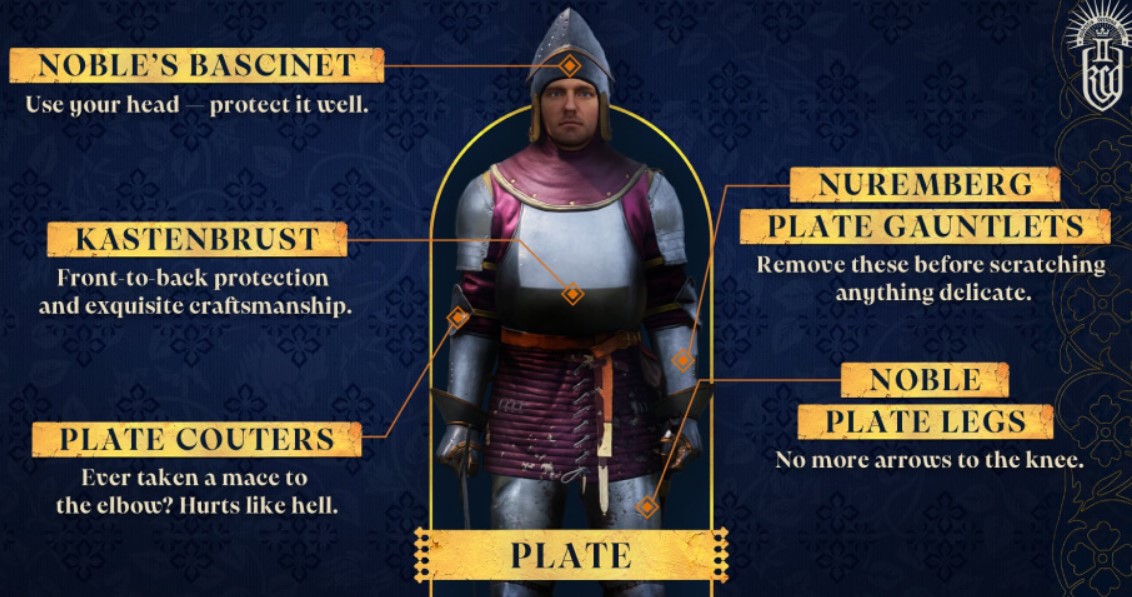
- Late Kuttenberg kit: Noble’s Bascinet, Milanese Cuirass, Nuremberg plate gauntlets, and Noble’s plate legs.
- Social variant: keep the plate and add a Brocade Hood for a large charisma boost.
- Stealth variant: strip the plate entirely for cloth and leather, and swap back before anything starts.
Is Body Armor Good for You in Kingdom Come: Deliverance 2 Economically?
Worth asking separately, because the answer is bracing. A full late-game Kuttenberg kit runs north of 20,000 Groschen. That is not a casual purchase, and it arrives on top of ongoing repair costs for gear that degrades as you wear it.
Three economic notes that change the calculation:
- Repair it yourself. It costs a fraction of blacksmith prices and raises the associated skill, so the saving compounds.
- Higher-tier gear resells for more, which makes looted Gold pieces worth hauling back even when you will never wear them.
- Degraded armour is a double loss, costing you defence in fights and charisma in conversations simultaneously.
For most of a playthrough the economically correct position is a strong mid-tier stack kept in good repair, rather than a premium piece you cannot afford to maintain.
Question Five: Good Compared to the Alternative?
The fifth and final version of the question is the only one with a clean answer, and it is not “yes” or “no.” It is: stop picking one. KCD2 is built around swapping kit by activity, and the inventory weight system exists precisely so you can carry more than one loadout.
| Activity | What to Wear | Why |
|---|---|---|
| Open combat and ambushes | Full stack, plate over mail over gambeson | Protection beats everything when swords are already out |
| Sneaking into a camp | Cloth and leather, no mail | Noise and visibility decide this, not defence |
| After committing a crime | Change entirely | Conspicuousness governs whether guards connect you to it |
| Haggling and persuasion | Clean, ornate, repaired gear | Charisma rises with quality and falls with dirt and blood |
| Long rides and travel | Lighter kit | Weight costs stamina regeneration even outside fights |
| Tournaments and duels | Heaviest you can carry at your Strength | No stealth stats matter, so pure defence wins |
The players who find armour frustrating are almost always wearing one outfit for all six rows. The players who find the system elegant are the ones treating the inventory as a wardrobe.
One More Thing Worth Knowing About Helmets
A short aside, because the head slot creates the sharpest version of every trade-off above. Helmets come in open-faced and closed varieties, and the difference is not purely defensive. A closed helmet narrows your field of view, which is a real mechanical penalty rather than a cosmetic effect – you genuinely see less of the fight you are in, and peripheral threats arrive without warning.
That turns the head into the one slot where maximum protection can make you worse at surviving. Against a single opponent in a duel, a closed great helm is excellent. Against four bandits circling you in woodland, the thing most likely to kill you is the man you did not see, and an open bascinet that lets you track him is the better armour despite the lower number.
It is the same lesson the rest of the system teaches, compressed into one piece of equipment: the stat on the item is not the same as the outcome in the fight.
A Note on the Numbers
One honest caveat before the FAQ, because this topic is full of confident figures.
The detailed stamina modifiers and defence values circulating in guides come from community testing rather than published developer documentation. Several of the most-cited sources contradict themselves internally – listing the same penalty as affecting maximum stamina in one paragraph and regeneration in another – and some are labelled as verified against a patch version that does not match their own footer.
The systems and relationships described above are reliable. The second decimal place is not. Check any specific number in your own game before building a character around it, particularly after a patch.
FAQ
Is body armour worth wearing in KCD2?
Yes for combat, where layered protection compounds substantially. But it costs stamina regeneration, raises noise and visibility, and increases conspicuousness, so it is actively bad for stealth and crime.
Can you wear plate without anything underneath?
No. Hard torso armour requires a gambeson or aketon beneath it, and the same padding-first rule applies to the head and legs.
What are the three defence types?
Stab, slash and blunt, tracked separately. Chainmail is strong against slashes and weak against blunt, while plate handles most types but can still be beaten by heavy blunt strikes.
Does heavy armour hurt stamina?
Yes. Community measurements put heavy armour at roughly a 20% regeneration penalty, rising to around 40% for full plate carried without enough Strength, alongside a reduction in maximum stamina.
What is conspicuousness?
A measure of how much you stand out, which determines how readily guards recognise and pursue you after a crime. It works against charisma, since ornate gear raises both.
What is the best early body armour?
The Saxon Brigandine from Blacksmith Osina at Trosky Castle, reaching stab defence around 144 at Gold quality, worn over a Hauberk Long and a gambeson.
How expensive is a full late-game set?
A complete Kuttenberg kit runs over 20,000 Groschen, before ongoing repair costs.
The Answer Is Yes, Billed Monthly
What Warhorse built here is an armour system in KCD2 that refuses to let protection be free. Every point of defence is paid for somewhere else – in the stamina you need to survive the fight it was bought for, in the noise that gets you caught before the fight starts, in the memory of the guard who will recognise you tomorrow, and in roughly 20,000 Groschen plus maintenance.
That sounds punishing written down. In play it is the opposite, because it makes getting dressed a decision rather than a menu. A player who pulls on a brigandine before riding to a bandit camp and strips to a linen shirt before climbing a monastery wall is playing the game as designed, and the system rewards that fluency more than it rewards any individual piece of gear.
So: is body armour good for you? Yes, when the thing about to happen is violence. The trick is knowing which of those evenings you are having before you leave the inn.
Heading out to Trosky this weekend? Share this, bookmark it, and pack a second outfit – and if creative or commercial collaboration brought you here, the BandurArt team is one message away.