Phantom Blade Zero Blackstone Is the Difficulty Setting Nobody Labels
The game gives you four difficulty modes at the start. Wayfarer, Pathbreaker, Hellwalker, and 66 Days, which is the permadeath-flavoured one with a death counter attached. There is a fifth, and you set it with your feet. Soul has no experience bar. There is no traditional levelling in Phantom Blade Zero at all – your damage, your energy, and your health come almost entirely out of things you find lying around the Phantom World. And the damage track, the Blackstone track, is the steepest of the three by a wide margin.
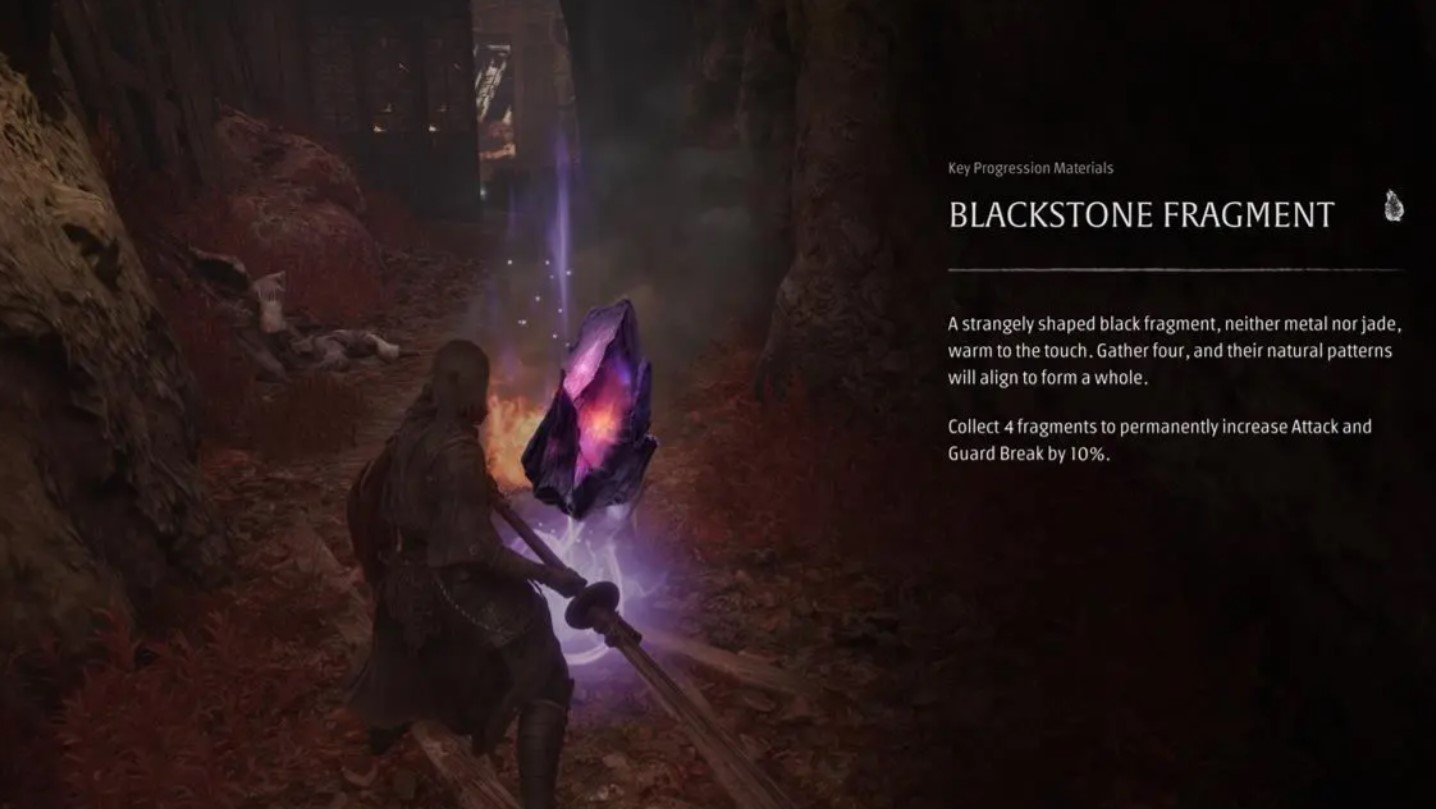
Forty shards exist. Four of them make one whole stone. Each whole stone raises your damage by ten percent.
Do that sum and the implication is uncomfortable: a player who finds everything hits for double what a player who rushed the campaign hits for, on exactly the same difficulty setting. That is a larger swing than most games allow their difficulty menus.
So this is written against the difficulty menu rather than as a collectible checklist. What the track is worth, where it is, how it compares to the dial you actually picked at the start, and when to stop chasing it.
The Arithmetic, Before Anything Else
The whole system runs on one conversion and it is worth stating plainly.
- 40 Blackstone Shards exist across the campaign.
- 4 shards combine into 1 whole Blackstone.
- Each whole Blackstone grants +10% Damage.
- 40 shards therefore equal 10 stones, which equal +100% Damage.
Nothing partial happens along the way. Three shards in your bag are worth exactly nothing until the fourth arrives, which changes how you should think about a region you are about to leave. Walking away with two shards banked is not progress you can spend – it is a debt the next region has to clear.
That quirk matters more than it sounds. If you are at 39 shards you are sitting on +90%, not +97.5%. The last stone is the only one that behaves like a milestone.
Where the Forty Blackstone Fragments Actually Lay
Here is the region-by-region count, which is the single most useful thing to know before you start, because the distribution is nothing like even.
| Region | Blackstone Shards | Worth in Whole Stones | Damage Added |
|---|---|---|---|
| Weeping Creek Valley | 4 | 1 | 10% |
| Crimson Forest | 6 | 1.5 | 15% |
| Village of Lu | 4 | 1 | 10% |
| Pangzhen | 12 | 3 | 30% |
| Mandate Encampment | 4 | 1 | 10% |
| Meigu Lake | 6 | 1.5 | 15% |
| Mountain of Imprisonment | 4 | 1 | 10% |
| Mount Soulrend | 0 | 0 | 0% |
| Total | 40 | 10 | 100% |
Pangzhen holds 30% of your potential damage on its own. Twelve shards, three whole stones, in one region – and Pangzhen is the region where the collectible count balloons generally, with 159 locations in total against Mountain of Imprisonment’s 32.
The other thing that table tells you is that Mount Soulrend has none. By the time you reach it, your damage ceiling is already fixed. Anything you did not collect earlier is gone from that playthrough unless you go back.
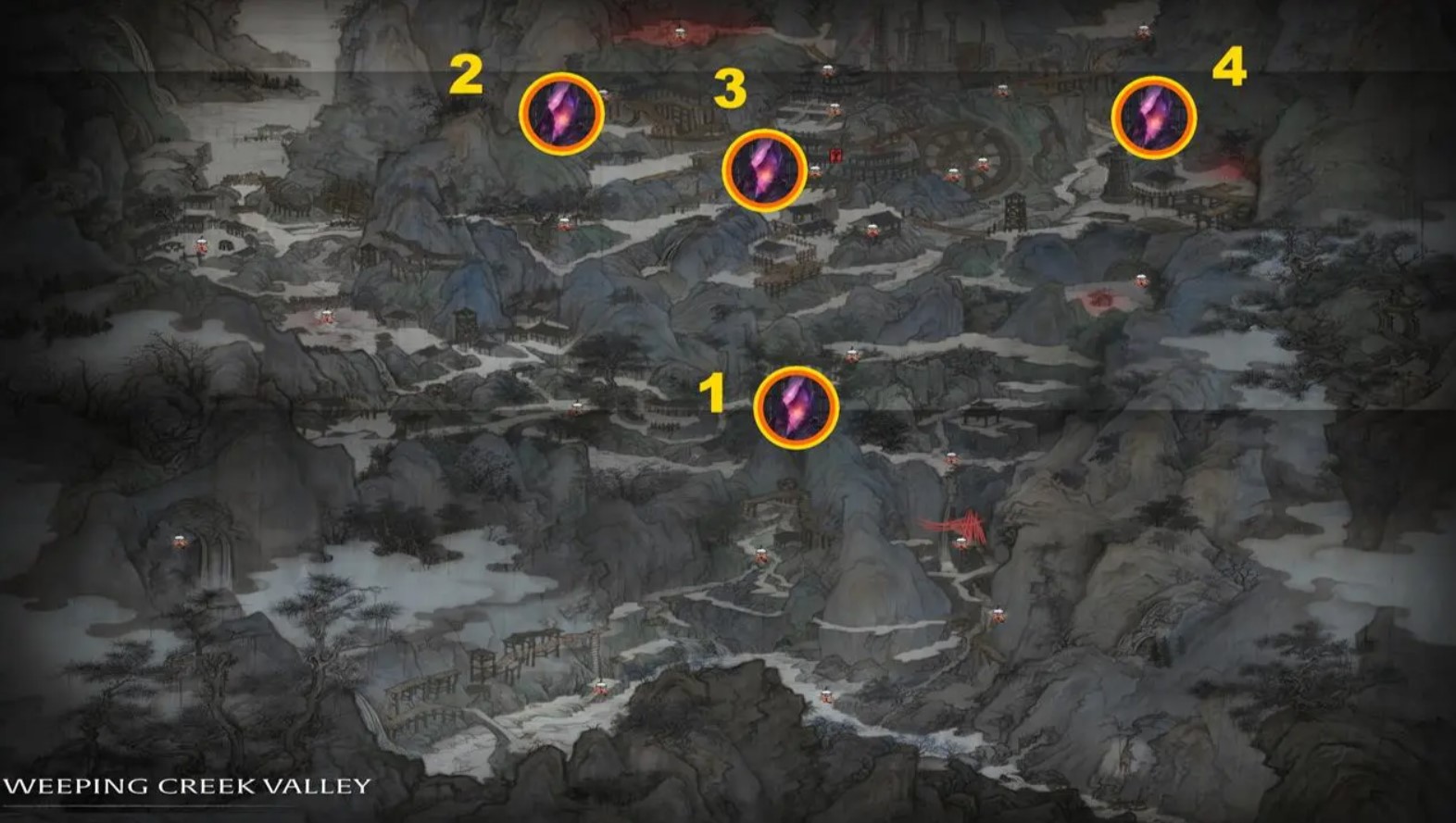
And a quieter pattern worth noticing: every region holds exactly as many Sha-Chi Amber Shards as Blackstone Shards. Four and four in Weeping Creek Valley, six and six in Crimson Forest, twelve and twelve in Pangzhen. The two tracks are deliberately paired one-for-one, region by region, which tells you S-Game treated offence and energy as a matched set rather than competing investments.
How Phantom Blade Zero Blackstone Shards Get Into Your Inventory
There are only four routes, and knowing them turns searching into something closer to pattern recognition.
Chests, usually behind something. The Weeping Creek Valley shard near the Outpost gate needs a Cell Key taken from a body in a courtyard up the stairs, then a trip back down a slope into a small cave. The Village of Lu has one in a chest slightly up the river from the Kuye Temple arena. Meigu Lake has one on a balcony behind a door that wants the Red-Cloth Door Key, and another in a gazebo that only becomes reachable once you have cleared the mist with the Illusory Pipa.
Individual enemy drops. In Weeping Creek Valley, a group of monks in a cave under a tower holds one between them. Near the Backstreet Rest Bell in Pangzhen, the enemies ahead of you carry one.
Clearing a whole encounter. This is the most common and the easiest to walk past, because the reward only appears once the last enemy is down. The archer camp up the hill from the Creek Valley Plains Entrance Bell pays out a shard and the Broken-String Bow together. Mountain of Imprisonment has one in an open area with a large enemy group on the main path, and another past a group guarding the way to the next cave. Mandate Encampment’s second watchtower works the same way.
Boss rewards. Mandate Encampment hands one over for beating Wu Lengshuang, The Soft Sword, alongside the Soft Snake Sword itself. Village of Lu puts one in a chest inside Zhou Bi, The Gatekeeper’s arena.
The practical lesson across all four: do not disengage from a fight you can win. This game hides a meaningful share of its damage ceiling behind enemy groups that look like optional friction. Running past a camp in Phantom Blade Zero is not a time saving, it is a stat cut.
How It Stacks Up Against the Difficulty You Picked
Now the comparison that makes this track interesting. The four official modes change what the world does to you. Blackstone changes what you do to the world, and because it is additive on top of weapon upgrades and accessories, it compounds with everything else you have invested in.
Consider the two ends:
- A thorough player on Hellwalker arrives at a late boss with ten stones banked, fully upgraded weapons and a tuned accessory set. The hard mode is doing its job, and the player has spent forty hours earning the right to survive it.
- A direct player on Wayfarer arrives with perhaps three or four stones, because they took what was on the main path and left the camps alone. The easy mode is carrying them, and the fight is probably still tense.
Those two experiences can end up closer than the menu suggests, which is the system working as intended. What it also means is the reverse case: a thorough player on an easier setting can flatten the back half of the campaign entirely. PC Gamer’s write-up, from more than fifty hours with the game, put it bluntly – it is not a particularly tough game unless you are on maximum difficulty, and finishing all the side content can leave the late game feeling easy.
So the honest framing is this. If you intend to collect everything, pick a harder mode than you think you want. The Blackstone track will meet you halfway and then some. If you intend to follow the story and move on, your chosen difficulty will mean roughly what it says on the tin.
The Two Tracks It Travels With
Blackstone is one of three pickup lines feeding Soul’s stats, and they do genuinely different jobs.
| Track | What It Raises | How It Works | Extra Notes |
|---|---|---|---|
| Blackstone Shards | Damage | 4 shards make 1 stone, each stone +10% | 40 total, none in Mount Soulrend |
| Sha-Chi Amber Shards | Energy reserves | Shards combine the same way | Matched one-for-one with Blackstone in every region |
| Memory Flowers | Maximum health | Found individually, also carry story fragments | Far more numerous – 33 in Pangzhen alone |
Memory Flowers come with a wrinkle worth knowing even if you only care about damage. Collecting all of a region’s Memory Flowers before fighting its boss can add an extra phase to that fight, or hand over a unique reward such as a weapon. So the completionist route does not only make you stronger – in places it deliberately makes the fight bigger to compensate. That is a smarter balancing instinct than simply scaling enemy health.
Separately, lore documents and examined objects pay out the dust currency that goes toward abilities and equipment upgrades, and much of the story’s actual substance lives in those optional notes rather than in cutscenes.
When to Chase Phantom Blade Zero Blackstone and When to Move On
Practical scheduling, because the answer is not always “collect everything now.”
- Clear tracked side quests in your current region before leaving. Some of them can fail outright if you move on, which makes them a harder deadline than the shards
- Blackstone itself is rarely urgent. The game has very few points of no return, so most shards stay collectable on a return trip
- Memory Flowers are the exception, since their bonus is conditional on finishing a region’s set before that region’s boss. If you want the extra phase or the unique reward, that is a one-time window
- Optional bosses can wait. Coming back later with more stones banked is a legitimate strategy rather than a cop-out
- Pangzhen deserves a dedicated pass. Twelve shards, 42 bells, 33 Memory Flowers and 159 total locations make it the one region where sweeping as you go beats a cleanup run
The counting quirk gives you one more scheduling rule. Finish in multiples of four. If a region leaves you on two spare shards, the sensible move is a short detour rather than a new chapter, because two shards carried forward are two shards doing nothing for however long the next region takes.
What This Means for a Launch-Day Run
Phantom Blade Zero is out on PlayStation 5 and PC from S-Game, who are both developing and publishing it, after a delay from its original September 9 date announced in June to allow more polish. It came in with over three million Steam wishlists behind it and a run of Most Anticipated Game awards from UCG and Ultra.
The shape of the thing, relevant to how you should treat Blackstone:
- Eight possible endings, influenced by which side quests you complete.
- New Game Plus opens after a first playthrough.
- Two primary blades and two secondary phantom edges at a time, all upgradable and pairable with accessories.
- Weapons and phantom edges can be reset to base level with your invested resources refunded – free up to level 10, and needing a reforge talisman after that.
- Sha-chi powers heavy attacks and blocking, which is why the amber track shares its distribution with Blackstone.
- Roughly 45 to 50 hours for a completionist run.
Put the endings and New Game Plus next to the Blackstone track and a sensible first-run plan appears on its own. Eight endings and a New Game Plus mean you are coming back anyway. So a first playthrough that collects thoroughly through Pangzhen and then relaxes is not leaving anything behind permanently – it is front-loading the damage curve for the half of the game where the bosses get serious, and keeping the remaining shards as something to mop up when the world is already familiar.
FAQ
What does Blackstone do in Phantom Blade Zero?
Each whole Blackstone raises your Damage by 10%. Four Blackstone Shards combine into one whole stone, so the full set of 40 shards gives +100% damage.
How many Blackstone Shards are in the game?
Forty, spread across seven of the eight regions. Mount Soulrend contains none.
Which region has the most Blackstone Shards?
Pangzhen, with twelve – three whole stones, or 30% damage, in a single region that holds 159 collectible locations overall.
Where do Blackstone Shards come from?
Four sources: chests that often sit behind a key or an environmental puzzle, drops from individual enemies, rewards for clearing an entire enemy encounter, and boss rewards such as Wu Lengshuang in Mandate Encampment.
Can you miss Blackstone Shards permanently?
Rarely. The game has very few points of no return, so most shards remain collectable on a return visit. Tracked side quests are the thing that can genuinely fail if you leave a region.
Is Blackstone the same as a Blackstone Fragment?
Yes. Guide overviews tend to say Blackstone Shard while per-region guides often say Blackstone Fragment for the same pickup.
Should you collect everything on your first run?
If you plan to, start on a harder difficulty. The damage doubling plus full weapon upgrades can make the late game feel soft, and with eight endings and New Game Plus available, there is no need to clear every region exhaustively the first time.
The Dial You Actually Control
Most action games put a slider at the front, scale enemy numbers behind it, and leave the player’s own power curve roughly fixed. Phantom Blade Zero does something closer to the opposite. There is no experience bar to grind, so the only lever on Soul’s damage is how carefully you walk through the world – and that lever has a hundred-percent range on it.
That is a lot of authority to hand a player without telling them. Nothing in the game announces that the archer camp up the hill is worth two and a half percent of your final damage output, or that skipping half of Pangzhen’s side content costs you more than dropping a difficulty tier would have given back.
Which is why the single most useful thing to know on launch day is not where each shard sits. It is the shape: forty shards, ten stones, double damage, with nearly a third of it concentrated in one city and none of it waiting for you at the end.
Count in fours. Clear the camps. Pick your difficulty like someone who intends to find everything, because the Blackstone track will absolutely meet you there.
Mapped your route through Pangzhen yet? Share this, bookmark it, and go clear a camp you were about to run past – and if creative or commercial collaboration brought you here, the BandurArt team is one message away.