
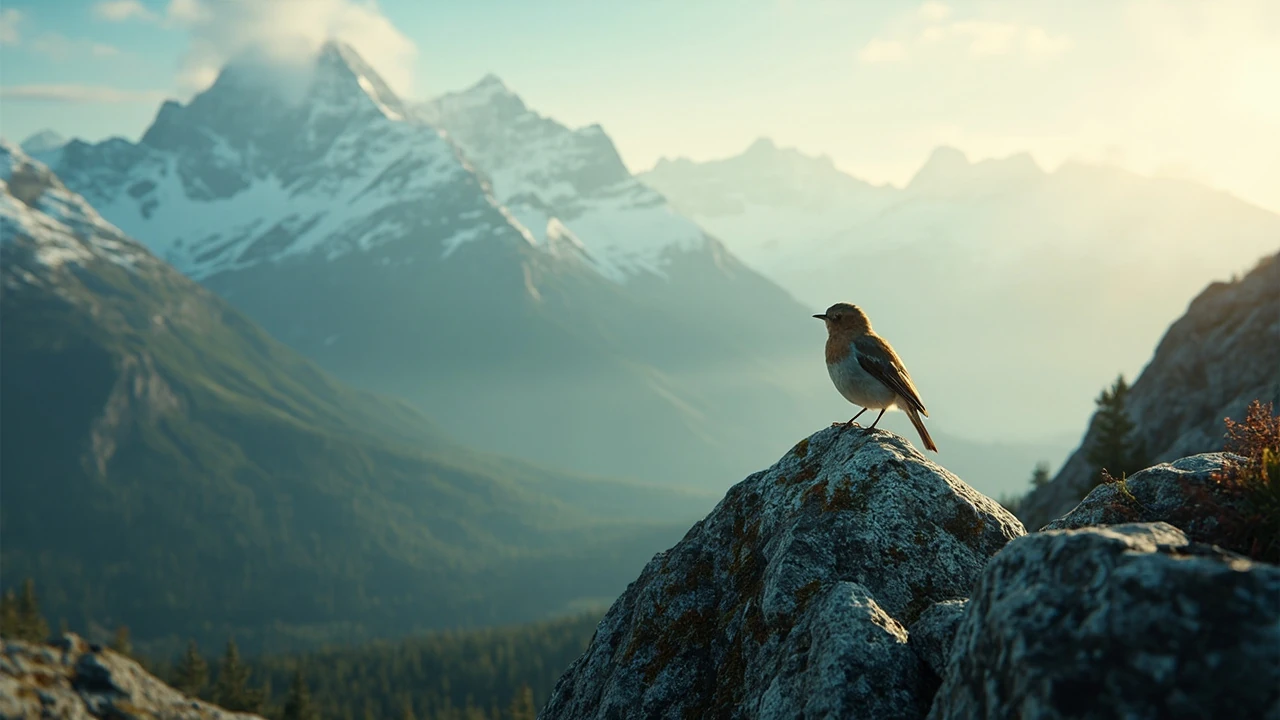
The bird in the mountains: a GameDev environment guide
A lone bird on a cold ridge sounds like a small detail, but in a mountain environment it is one of the highest-leverage pieces of ambient storytelling a team can ship. The shape of the silhouette, the direction the bird faces, the moment it leaves the rock and the way the audio mix opens up behind it all carry meaning that the player feels before they can name it. When a studio treats the bird as a designed object instead of a decorative prop, it becomes a navigation cue, a wayfinding landmark, a pacing tool, and a quiet reward for exploration, all in the same five seconds of screen time.
This article is a working production guide for designers, technical artists, animators, audio leads, and producers who want to ship a mountain bird encounter that holds up under playtest scrutiny. It walks through intent, level placement, rig and animation, behaviour, audio, performance, and validation, then closes with a practical checklist and a focused FAQ. The aim is the same on every project: make the bird in the mountains read as intentional, not as background noise.
Why a single bird deserves a real design brief
It is tempting to drop a bird in as a particle or a flipped skinned mesh and move on. In practice, an environment bird is doing three jobs at once: it is establishing scale, it is signalling life in an otherwise empty vista, and it is giving the camera and the player something to track. Each of those jobs is cheap to get wrong and cheap to get right if the team plans for it.
Scale is the first job. A well-modelled bird at a believable distance lets a player gauge the size of a cliff face or the depth of a valley. If the silhouette is too small, the world feels flat. If it is too large, the world feels like a diorama. The bird becomes a measurement tool, and that is exactly what the level designer needs from a distant animation on a ridgeline.
Signalling life is the second job. Mountains in games are visually loud and biologically sparse. Without movement, the player subconsciously reads the scene as abandoned. A bird that turns, preens, calls, and eventually takes off gives the scene a heartbeat. The motion does not need to be fast. Slow, deliberate motion reads better at distance than frantic flapping, because the player’s eye is on the midground and not on the bird itself.
Camera and player focus is the third job. A well-placed bird gives the player a target that is not the objective marker. In open-world games this is a navigation trick: a visible bird above a path leads the eye down the path. In linear games it is a pacing trick: a bird in frame tells the player the cinematic moment has begun without a hard cut. The bird in the mountains is one of the few design elements that supports both the open and the directed reading at the same time.
Defining the design intent before the rig is built
Before anyone models the bird, the team needs a one-paragraph intent statement. The statement does not need to be literary, but it does need to answer three questions: what is the bird doing here, what should the player feel, and what should the player do next. Those answers drive the rig, the animation set, the audio, the placement, and the QA pass.
A practical intent template
A useful template for a mountain environment bird looks like this:
- Role: landmark, wayfinding, ambient life, or quest beat.
- Player feeling: solitude, calm, awe, warning, or anticipation.
- Player action: continue forward, stop and observe, follow, or investigate.
- Distance band: foreground (under 8 m), midground (8 to 40 m), or background (over 40 m).
- Frequency: one per region, one per vista, or one per encounter zone.
Filling the template in advance stops two common failures. The first failure is the bird that does not know what it is. It is a quest marker on one screen, a random ambient on the next, and a wayfinding tool on the third, and the player stops trusting any of those readings. The second failure is the bird that tries to do everything at once and ends up doing nothing clearly. The intent template forces a choice, and the choice is what makes the bird feel designed.
Picking a species and a silhouette that read at distance
Silhouette is the only readable property of a small object against a bright sky or a far ridge. The team has to choose a species whose outline still tells the player it is a bird at 60 m, and that means paying attention to head shape, tail length, and wing profile rather than plumage detail.
| Silhouette family | Readable at distance | Common use in mountain scenes | Notes for the rig |
|---|---|---|---|
| Compact raptor (eagle, hawk) | Strong | Background landmarks, quest beats | Broad wings, short tail, deep flaps |
| Long-tailed corvid (raven, chough) | Strong | Atmospheric, cliffside ambient | Wedge tail, steady wingbeats |
| Slim songbird (swallow, dipper) | Moderate | Midground animation, water edges | Pointed wings, fast agile flaps |
| Game bird (grouse, ptarmigan) | Moderate | Snow scenes, ground encounters | Rounded body, short bursts |
| Waterfowl (duck, goose) | Weak at altitude | Rare; mostly near lakes | Long neck, large body |
The table is not a rule of biology. It is a readability chart. The species chosen should match the altitude, the climate, and the visual language of the rest of the biome. A raven on a basalt cliff reads as honest. A raven on a tropical beach reads as a mistake, even if the mesh is the same. The honest choice is also the cheaper choice in QA, because playtesters flag a mismatch faster than they flag a low-resolution texture.
Plumage and material budget
From the midground onward, plumage is not readable, but the way the body catches light is. The team should invest in a material that responds correctly to rim light, that does not break under subsurface scattering at very thin edges, and that reads as matte from above and slightly iridescent from below if the species calls for it. A simple two-layer feather map is usually enough. The temptation to ship a full groom of individual feathers is real, but it rarely pays off at the scale of a background bird and it always costs draw calls.
Animation states a mountain bird actually needs
A bird in a mountain scene needs fewer states than a companion bird in a city scene, but each state has to be bulletproof. The states below cover roughly 90 percent of the real production use cases on a mountain environment pass. Anything more is usually a sign that the rig is trying to do work that should belong to the level or the audio.
The minimum state set
- Idle perch: breathing, head turn, weight shift, occasional preen.
- Alert: upright body, head locked, tail flick, single call.
- Take-off: crouch, wing extension, two strong flaps, lift.
- Glide: wings held, slight banking, occasional wing tuck.
- Flap: predictable wingbeats with a strong downstroke.
- Land: approach glide, tail flare, foot plant, settle.
Each of these states has to blend into the next without an obvious pop. Take-off into glide and glide into land are the two transitions that always show their seams if the rig is rushed, because the wing timing changes in both. The fix is to author a small in-between buffer and to use a time-warped blend rather than a linear one, so the wingbeat speed up or slows down smoothly across the transition.
Distance-based animation switching
Distance bands should drive animation quality, not just mesh LOD. A bird in the background does not need a preen animation that the player will never see, and a bird in the foreground does not need a constant 30 Hz wing flap. A useful pattern is to author a single high-quality animation set and to drive quality, not behaviour, from the camera distance. Behaviour changes should be event-driven, not distance-driven, so the player never sees a bird freeze at the wrong moment.
| Distance band | Mesh LOD | Animation rate | Behaviour scope |
|---|---|---|---|
| Foreground (0 to 8 m) | LOD0, full feathers | 30 Hz, full state set | Perch, alert, preen, take-off, call |
| Midground (8 to 40 m) | LOD1, simplified feathers | 15 Hz, reduced blend | Perch, take-off, glide, call |
| Background (40 m and beyond) | LOD2, billboard or impostor | 10 Hz, looping clip | Glide, slow flap, scripted path |
Behaviour trees versus scripts for a single bird
There is no single right answer here. The choice depends on how many birds will be live in a scene at once, what the AI budget looks like, and how much the bird needs to react to player actions. The most common mistake is to over-engineer one bird with a behaviour tree that a simpler script would have solved in a morning.
For a scene with one or two featured birds, a simple state script with timed transitions and a small set of audio triggers is usually enough. The script reads more cleanly, the QA team can reason about it, and the audio lead can plan a fixed call pattern around it. A behaviour tree starts to earn its keep when a scene carries six or more birds that need to react to the same stimulus at slightly different times, or when the bird is part of a larger creature system that already uses a tree.
Whatever the choice, the team should decide in advance how the bird will respond to four stimuli: player proximity, sudden noise, time of day, and weather. A mountain scene that includes weather cannot have birds that ignore rain without breaking the scene, and a scene that includes time of day needs at least a roost and a wake-up behaviour for credibility.
Audio design for a mountain bird encounter
Audio is the half of the experience that the player will remember longest. A For additional context, bird that looks right but sounds wrong is jarring; a bird that looks average and sounds right is forgiven. The audio team has to plan for the bird’s role in the mix, the distance at which it should be heard, and the way the call should sit against wind, water, and the player’s own footsteps.
Layers of a mountain bird mix
- Close call: detailed, dry, near-field, around 1 to 3 m.
- Mid call: medium detail, a touch of room, around 5 to 15 m.
- Distant call: simplified, more reverb, low-passed, 20 m and beyond.
- Wing noise: only at very close range, used sparingly for impact.
- Flock layer: optional, used only when the scene carries more than two birds.
The close call is where the team’s recording budget has to land. A single good close call with three variants is worth more than twenty average ones. The distant call is where the system can save budget, because a low-passed and slightly detuned version of the close call reads as distance without paying for additional assets. The audio lead should author at least one of these variants per role, and the implementation team should set the crossfade distance in the audio middleware, not in a per-bird script, so that all mountain birds behave consistently.
Wind and weather interaction
Mountain wind is a character in the scene as much as the bird is. A call that ignores wind sounds fake at any distance, and a call that fights wind sounds worse. The cleanest pattern is to feed the scene’s wind parameter into the bird’s call volume, so the bird naturally quiets as wind picks up and re-emerges as wind dies down. The same parameter can drive a low-pass filter on the call to suggest attenuation. This is cheap to implement and immediately makes the bird feel like it belongs.
Placement and wayfinding on a mountain level
Placement is where the design intent becomes player experience. A bird in a mountain scene should be placed the way a cinematographer places a stand-in for the actor: in the line the player is most likely to look, at the moment the player most needs a cue. A common production pattern is to place one featured bird per vista, with two or three background birds per vista, and to keep the spacing generous.
| Vista type | Featured bird | Background birds | Placement guidance |
|---|---|---|---|
| First reveal of a valley | One, midground, gliding | Two to three, high background | Place featured bird 30 to 50 m off the player’s path, slightly above eye level |
| Climb up a ridge | One, foreground, perched | None or one distant | Place featured bird on the highest visible point of the next ridge |
| Campsite or save point | One, near, perched | Two distant, near water or trees | Place featured bird within 5 m, oriented toward the player path |
| Climax or vista payoff | One, dramatic, take-off or call | Three to four, mixed | Time the call or take-off to the moment the camera settles |
| Quest or story beat | One, scripted | Adjust to support the beat | Coordinate with the cinematics team to avoid competing cues |
The numbers in the table are a starting point, not a rule. Every project has its own scale and its own camera FOV, so the team should validate placement with at least one playtest on the target hardware before locking it. A bird that reads as a landmark on a 24-inch monitor can disappear on a 65-inch TV, and vice versa.
Performance and technical budget for an environment bird
A bird is a small object, but small objects in mountains tend to come in flocks, and flocks in open worlds are the fastest way to find the budget hole. The team’s first task is to set a per-frame and per-scene budget for the bird system and to enforce it.
Typical budget for a mountain environment
- Per frame on a mid-tier target: 0.2 to 0.4 ms for the entire bird system, including animation, AI, and audio query.
- Triangles per foreground bird: 1,500 to 3,000 triangles, depending on species and silhouette needs.
- Triangles per midground bird: 600 to 1,200 triangles.
- Background birds: impostor or animated billboard, with a cap on overdraw.
- Draw calls: batch by species and LOD where the engine supports it; avoid one material per bird.
Animation can quietly become the largest cost in the budget. A 30 Hz rig with full state blending is fine for one foreground bird but adds up fast across a vista. Two mitigations almost always pay off. First, use shared skeleton assets across species that share rig logic, even when the mesh differs. Second, push as much animation as possible to the GPU through the engine’s animation system if it has one, so that the main thread only does state transitions and events.
Audio also needs a budget. A bird that triggers a unique close call every two seconds will eat the audio voice count quickly. The audio lead should set a global cap on bird voices per scene, with a clear pecking order for which birds earn a voice in heavy moments and which go quiet. The team should test the cap on a crowded vista before signing off on the scene, because audio dropouts are easy to miss in single-bird reviews.
AI, scripting, and event hooks
Even a small bird is an actor in the scene, and like any actor it needs hooks. The most useful hooks are simple, named, and stable across patches, because they will be used by the quest team, the audio team, and the cinematics team for the entire life of the project.
A small set of useful hooks
- OnTakeOff: fires the moment the bird leaves its perch.
- OnLand: fires when the bird reaches its next anchor.
- OnCall: fires on each call, with a parameter for call type.
- OnAlert: fires when the bird enters the alert state.
- OnScared: fires when the bird reacts to a player or predator.
These hooks should be authored once and exposed through the engine’s scripting layer. They should not be hard-coded into the bird’s behaviour script, because that ties the bird to a single use case and makes future reuse painful. A bird that can be reused across exploration, ambient, and quest content is a bird that will keep paying for itself across the production schedule.
Working with cinematics, audio, and the lighting team
The bird in the mountains lives at the intersection of three disciplines: animation, audio, and lighting. A team that treats it as an animation asset will get a beautiful bird that is inaudible at the right moment. A team that treats it as an audio asset will get a beautiful sound from a paper-thin silhouette. A team that treats it as a lighting study will get a beautifully lit bird that does not move with the rest of the scene.
The cleanest pattern is a short shared review at three milestones. The first review covers intent and placement, before any rig work is committed. The second review covers the rig and animation, with rough audio placeholders, before the scene is lit. The third review covers the final scene, with full audio and lighting, on the target hardware. Each of those reviews can be 20 minutes if the intent template is filled in advance. Skipping them is what produces beautiful birds that get cut from the final game.
Common failure modes and how to spot them in QA
Most mountain bird problems fall into a small number of categories, and most of them show up in the first ten minutes of a playtest. A short QA checklist is often worth more than an extra polish pass.
QA checklist for the bird in the mountains
- Read the silhouette at 60 m against a clear sky and against fog.
- Confirm the bird does not freeze at the distance band transition.
- Confirm take-off into glide does not show a wing pop.
- Confirm calls respond to wind and time of day.
- Confirm no more than N voices are active in a busy vista.
- Confirm the bird does not clip into cliffs, trees, or the player.
- Confirm the bird’s path does not cross the objective marker at the wrong moment.
- Confirm the bird does not pop in on a fast camera turn.
- Confirm the bird responds correctly to rain or snow if the scene has weather.
- Confirm the bird’s call does not mask an important quest or UI cue.
Each of these is a known failure mode. The check is not to confirm the team did the work; it is to confirm the work survived contact with the rest of the scene.
A small production timeline for shipping a mountain bird
Production timelines for a single environment asset are easy to underestimate. The bird is small, the budget is small, the scope is small, and then a week disappears into a single animation transition. A useful target for a mid-sized team on a mid-sized project is one week of focused work from first rig to scene-ready, with a clear buffer for the final review.
| Day | Focus | Deliverable |
|---|---|---|
| 1 | Intent, species, silhouette | One-page intent document, reference board |
| 2 | Mesh, materials, LOD | Three LODs, two material variants |
| 3 | Rig and idle | Working rig, idle perch animation |
| 4 | Take-off, glide, land | Full state set with transitions |
| 5 | Behaviour and hooks | Script with five hooks, one scene test |
| 6 | Audio pass and review | Three call variants, wind and weather hook |
| 7 | QA pass and sign-off | Checklist complete, no blockers |
The timeline assumes a senior animator and a senior audio designer working in parallel, with a producer carrying the dependency list. It is not a contract. It is a sanity check. If the team is consistently missing day 4, the rig is too ambitious for the role, not the team.
Reusing the bird across the game
The cheapest bird in the mountains is the one that already exists. Once the team has a working rig, the variants that pay off the most are species swaps, plumage swaps, and behaviour swaps, in that order. A raven rig can become a crow rig with a material change and a tail tweak. A raven rig can become a hawk rig with a silhouette tweak and a state change. Each reuse is a small saving that compounds across a 30 to 80 hour game.
The team should keep a small library of mountain birds, with consistent LODs, consistent hooks, and consistent audio variants. The library should be owned by one animator and one audio lead, with a clear change request path. Without that ownership, the library drifts and the saving disappears.
Putting it together: a one-page brief for the bird in the mountains
For a team that wants to start tomorrow, the brief below is the smallest document that still produces a credible result. Fill it in, share it, and let it drive the next seven days of work.
- Role: landmark and ambient life on the high ridge vista.
- Player feeling: solitude and a sense of scale.
- Player action: continue forward, with a brief look.
- Species: raven or chough, depending on biome palette.
- Distance band: midground to background, with one foreground perched bird near the vista edge.
- Animation set: idle perch, alert, take-off, glide, land.
- Behaviour: script-driven with a single take-off cue at 8 to 12 seconds.
- Audio: one close call, one mid call, one distant variant, all wind-aware.
- Performance budget: 0.3 ms per frame on the mid-tier target, 4 active birds per vista max.
- Hooks: OnTakeOff, OnLand, OnCall, OnAlert, OnScared.
- QA gates: silhouette at 60 m, transition pop check, voice cap, weather response.
- Reuse plan: share rig with future corvid and raptor variants.
The brief is intentionally short. If the team cannot fill it in, the project is not ready for the bird. If the team can fill it in, the next step is one of the production patterns described above, and the bird in the mountains becomes a small, dependable piece of the world rather than a forgotten background detail.
Frequently asked questions
What is the best way to make a mountain bird read as a landmark?
Place the bird on the highest visible point of the next ridge, midground to background, with a silhouette that holds at 60 m. Add a single, well-timed take-off or call to anchor the player’s eye, and resist the temptation to add more movement. One clear landmark beats three busy ones.
How many birds should be alive in a single vista?
One featured bird per vista, with two or three background birds, is a strong default. The total active count depends on the audio and CPU budget, but more than four foreground birds almost always reads as crowded in a mountain scene and dilutes the landmark effect.
Should the bird use a behaviour tree or a state script?
For one or two featured birds, a state script is faster to author, easier to debug, and easier to coordinate with the audio team. A behaviour tree earns its keep when a scene carries six or more birds that need to react to the same stimulus with variation, or when the bird is part of a larger creature system that already uses a tree.
How do I keep the animation cheap on the mid-tier target?
Author a single high-quality state set and drive quality from the camera distance, not the behaviour. Use shared skeleton assets across species, push animation to the GPU where the engine supports it, and cap the number of birds that can run full blend at one time per scene.
What is the most common reason a mountain bird feels off in playtest?
Take-off into glide is the most common failure mode, because the wing timing changes and the seams show. The fix is a small in-between buffer and a time-warped blend, validated in the actual scene rather than in the animation tool. A close second is a call that ignores the scene’s wind parameter.
Do background birds need their own audio, or can I reuse the close call?
Reuse the close call as the source for a low-passed and slightly detuned distant variant. The reuse is cheaper, the consistency is better, and the player perceives the distant variant as the same bird at a different range. Author at least one of these distant variants per role and set the crossfade in the audio middleware.
How should the bird respond to weather and time of day?
Feed the scene’s wind parameter into the bird’s call volume and a low-pass filter, and feed the time-of-day parameter into a small state change. A mountain scene that includes rain or snow without a bird response breaks the scene’s credibility faster than almost any other detail, so the weather hook is a priority, not a polish item.
What is the minimum QA pass for a mountain bird before sign-off?
The ten checks in the QA list above are the minimum. The most common shortcuts are skipping the 60 m silhouette check and skipping the transition pop check. Both are cheap to run, and both catch the failures that players notice in the first minute of a session.
Can the same rig power a raven, a crow, and a hawk?
Yes, with care. A shared corvid rig can cover a raven and a crow with material and silhouette tweaks, and a shared raptor rig can cover a hawk and a falcon with wing shape and tail tweaks. A raven to a hawk jump is harder and usually means a second rig, but the animation system and hooks can still be shared.
Where can a team learn more about mountain birds as a real-world reference?
Field recordings, regional bird guides, and well-curated reference footage are the foundation. For background on the geography and the cultural context of mountain bird life, the Bird Mountain entry on English Wikipedia is a useful starting point for place names, terrain, and the kinds of species that share these cliffs. Combine that with local ornithology sources for the species in your biome, and you have a reliable reference library for art, animation, and audio.