Absolute Bane: how a redesigned Bane reframes brute force for a new universe
Absolute Bane is the Absolute Universe’s reinvention of one of DC’s most recognisable physical threats. Instead of the classic South American mercenary who breaks backs with a pumped-up super-soldier serum, this version is built around a different origin, a different body, and a different relationship with fear. For readers, that means a Bane who feels structurally distinct rather than simply darker. For game developers and designers looking at how a single villain archetype can be reworked, the character is a useful case study in how combat mechanics, narrative framing, and visual identity reinforce each other.
This guide breaks down who absolute Bane is, how the design differs from classic Bane, the powers and tools that define him, and what those choices mean if you are porting the character into a fighting game, a narrative adventure, an MMO boss fight, or a tabletop adaptation. It also covers how to read the source material, where the redesign stops being a coat of paint, and which design decisions are likely to influence future game appearances.
Who absolute Bane is in the Absolute Universe
The Absolute Universe line, launched in 2024, reimagines DC’s flagship heroes and their adversaries by stripping away their traditional advantages and rebuilding them in a grounded, sometimes harsher setting. Absolute Batman, written by Scott Snyder with art by Nick Dragotta, leads the line and is the anchor that absolute Bane is built around. As Snyder and Dragotta describe in their discussion of the new continuity, the goal is not to invert the characters for shock value but to ask what each one would look like if their familiar support systems, resources, and origins were removed.
For absolute Bane, that means discarding the cartoonish serum model that has defined the character since the 1990s films and many animated appearances. The redesign keeps the core idea of a villain who represents overwhelming physical force, but it changes how that force is acquired, sustained, and deployed. He is no longer a hired mercenary who walks into Gotham with a vial. He is shaped by the environment of the Absolute Universe from the ground up, and his combat style reflects that.
If you are approaching him purely as a reader, this matters because his threat level no longer depends on a single prop. If you are approaching him as a designer, it matters because every part of his move set has to be coherent with a character who does not rely on a temporary power-up. There is no moment where the mask comes off and the effect wears off. There is only the character, the training, and the tools.
How absolute Bane differs from classic Bane
Classic Bane is, in most modern adaptations, a chemically enhanced super-soldier. The Venom compound floods his system and grants strength far beyond baseline, at the cost of addiction, dependency, and a withdrawal that leaves him vulnerable. That model is easy to translate into games because it gives designers a clean power curve: low stats normally, very high stats under Venom, and a hard debuff window if the buff is removed. It is a textbook boss design pattern.
Absolute Bane breaks that pattern. Instead of a chemical toggle, his strength comes from a different mix of training, environment, and equipment. The result is a character whose baseline threat is high, whose power is not tied to a single resource, and whose dramatic reversals have to come from elsewhere, such as tactics, narrative pressure, or environmental change. For a game, that pushes the design away from the buff-and-debuff pattern and toward something more like a heavy grappler with permanent tools and a specific set of counters.
The table below summarises the practical differences for anyone adapting the character.
| Attribute | Classic Bane | Absolute Bane |
|---|---|---|
| Primary power source | Venom serum, applied through a mask delivery system | Training, physique, environmental context, and equipment |
| Baseline combat ability | Skilled but not superhuman without Venom | High baseline strength, close to or above peak human without external aid |
| Tactical role | Heavy bruiser, mastermind of physical and psychological traps | Heavy bruiser, with a stronger emphasis on direct confrontation and endurance |
| Weakness pattern | Withdrawal after Venom wears off, addiction, mask removal | Confronted through strategy, allies, environment, or sustained counter-pressure |
| Visual signature | Tank top or jacket, luchador-style mask, tubes feeding the mask | Heavy, grounded silhouette, modified mask, practical combat gear |
| Game design hook | Buff window, debuff vulnerability, resource management | Permanent threat, no power-down phase, different counterplay |
The shift is subtle in print but significant in implementation. Designers who simply reskin classic Bane and keep the Venom mechanic will not be representing absolute Bane. They will be representing a recoloured version of a character who was deliberately redesigned to operate without that mechanic.
Powers, abilities, and combat profile
Absolute Bane’s move set is built on a small number of well-defined strengths. Understanding them in isolation is the first step toward any game adaptation, because it sets the boundaries for what the character can and cannot do in a system.
- Peak-level strength. He can overpower trained combatants and bend or break standard materials. Damage scaling in a game should treat his strikes as heavy, not as area-of-effect explosions.
- Combat endurance. He absorbs and keeps fighting through injuries that would end a fight for most opponents. Stamina and damage-over-time interactions matter more than a single health bar.
- Grappling and control. He locks opponents in close range, denies escape, and punishes attempts to disengage. Designers usually implement this through command-grab moves, hold states, or push-and-pull pressure.
- Pressure through presence. He is most effective when he controls the space around him. Movement speed, reach, and zoning pressure should reinforce this rather than rely on projectiles.
- Tactical intelligence. He is not a wild berserker. He reads opponents and adjusts. In gameplay terms, this can be expressed through pattern adaptation, a reactive second phase, or a cooldown shift after observing player behaviour.
For combat-heavy games, these traits suggest a character that fits a heavy grappler or boss archetype. For narrative-led games, they suggest a villain who dominates scenes through posture, restraint, and the implied threat of violence as much as through the violence itself.
Visual and costume design choices
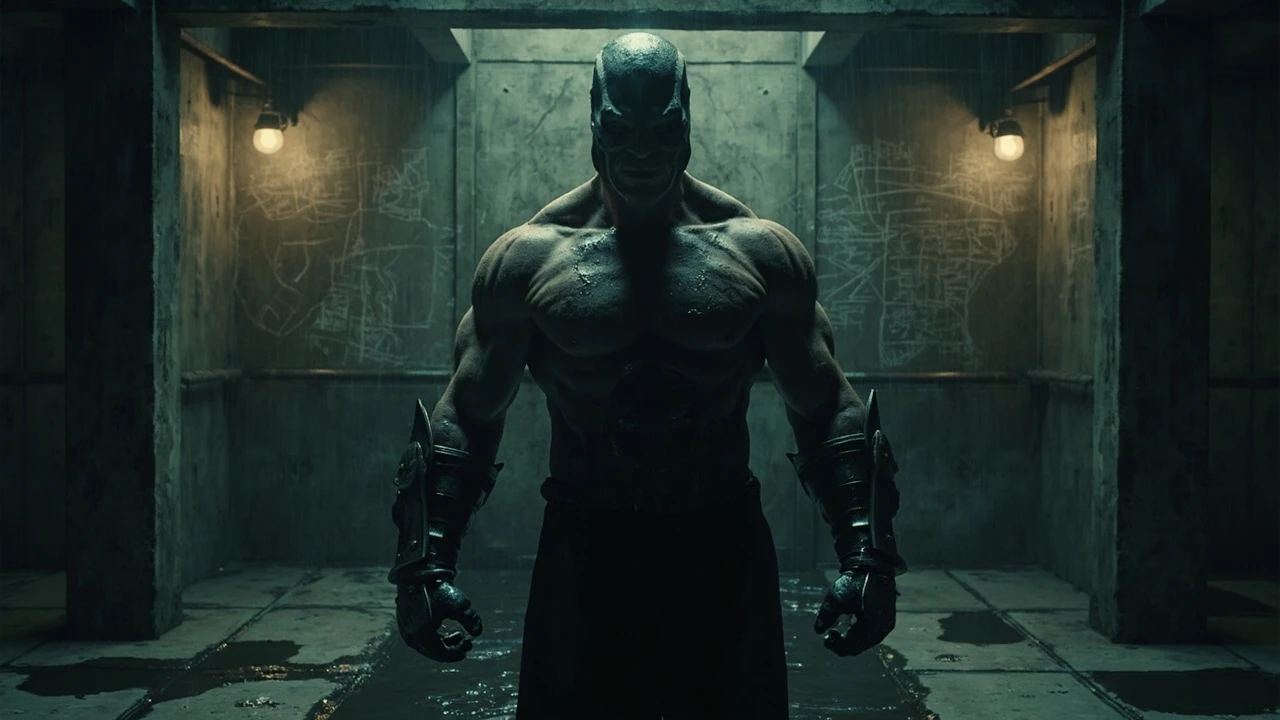
The silhouette of absolute Bane is part of the design language. He reads as heavy, low, and grounded. The mask is preserved as a recognisable Bane element, but it is treated as a piece of practical headgear rather than a glowing chemical apparatus. The tubes that defined the classic look are replaced or refunctionalised, and the rest of the costume is built from materials that suggest durability rather than spectacle.
That visual restraint is a deliberate choice. Snyder and Dragotta’s broader goal with the Absolute line is to keep characters visually identifiable while changing the parts of their design that no longer fit the new continuity. The mask stays because the mask is part of the character’s identity. The tubes go because they are tied to a mechanic that is no longer the point of the character.
For artists and technical artists working on a game adaptation, the practical takeaway is that absolute Bane can be modelled with a smaller number of custom assets than classic Bane. He does not need the complex tube-and-mask rig, the canister attachments, or the animated fluid effects. He needs a heavy body, a clean mask, and surface details that suggest history and use.
What absolute Bane means in gameplay terms
A redesigned Bane has to solve a problem that most fighting games and boss encounters already have: how do you make a heavy character feel heavy without making the fight feel unfair? Classic Bane solves that with the Venom window, which is a built-in risk for the player controlling him. Absolute Bane removes that window, so the design has to do the balancing elsewhere.
Common approaches in modern games include longer recovery frames on his strongest attacks, a limited number of command-grab uses before a brief reset, a movement speed that is slower than mid-weight characters, and a hitbox that is large but predictable. These are not new mechanics; they are normal design choices applied to a character whose baseline power is closer to a boss than to a standard fighter.
For a non-fighting game, the same logic applies differently. In an action-adventure game, absolute Bane works best as a boss with phases defined by location and ally support rather than by a power toggle. In a narrative RPG, he works best as a presence that limits player options in a region, forcing the player to plan around his patrol rather than engage on sight. In a tactical or turn-based game, he is a unit that punishes overextension and rewards positioning.
What unifies these approaches is that absolute Bane is a pressure character. He does not need a power spike to be dangerous. He is dangerous by default, and the design challenge is to make that danger readable and fair.
Designing an absolute Bane boss encounter
If you are building a boss fight around this version of the character, the structure of the encounter matters more than the specific numbers. The encounter has to communicate three things: that the boss is strong, that the boss is not random, and that the player has a realistic path to victory.
For absolute Bane, the strongest signal of strength is visual. He should not flinch from light attacks. He should not stagger the way a mid-weight enemy does. He should take space deliberately, and the player should feel the cost of being in that space. The strongest signal of intelligence is pattern. He should attack in sequences that the player can learn, with a small number of clearly telegraphed openings. The strongest signal of fair design is a clear path: a way to break his guard, a way to interrupt a hold, a way to end a phase.
A common mistake is to lean on one-shot attacks. They feel cheap rather than heavy, and they push the player toward trial-and-error rather than learning. A better approach is to give him a small set of high-damage moves that the player can recognise, and a longer list of moderate moves that fill the space between them. That keeps the encounter dangerous without making it feel arbitrary.
| Encounter element | What absolute Bane does well | Common pitfall to avoid |
|---|---|---|
| Visual read | Heavy, grounded silhouette; minimal but specific costume details | Floating cloth, glowing tubes, and visual noise that fights the silhouette |
| Damage profile | High per-hit damage with small combo chains | Long, screen-clearing combos that lock the player out |
| Mobility | Slow, deliberate movement that controls space | Instant teleports or flight that contradict the heavy archetype |
| Counterplay | Learned pattern with a small set of clean openings | One-shot grabs with no telegraph |
| Phases | Environmental or ally-driven transitions | Stat-scaling phases with no narrative or spatial change |
The phases, in particular, are a place where designers often overreach. Scaling a boss’s numbers from 100 percent to 200 percent does not change the fight. Moving the boss to a new arena, changing the set of enemies that support him, or changing the resources available to the player changes the fight. That is the kind of phase design that absolute Bane’s character supports, because the character is not defined by a power toggle.
Adapting absolute Bane across game genres
The same character behaves differently in different genres, and a good adaptation respects that rather than copying a single template.
- Fighting games. Treat him as a grappler with high damage and slow walk speed. Give him one or two command grabs, a punish counter, and a super that rewards a read rather than a reaction. His pressure should feel oppressive in the corner and survivable in the mid-range.
- Action-adventure games. Use him as a regional threat. Heavily armoured, slow, and present in specific zones where the player’s tools are limited. The fight against him should be a set piece, not a recurring encounter, and it should be lost on the first attempt in a way that teaches the player rather than punishing them.
- Action RPGs. He works as a high-health enemy with a small move pool and heavy hit reactions. Status effects and stagger windows give the player counterplay without breaking his threat level.
- Tactical and turn-based games. He is a single high-cost unit that punishes clusters and weak positioning. He should be vulnerable to control effects and to focused fire, but he should be able to delete a poorly placed squishy target in one turn.
- Tabletop and card games. He is a high-stat character with limited actions per turn. The design should reward players for building around his strengths rather than trying to patch his weaknesses with a resource he does not have.
Across all of these, the through-line is that absolute Bane is a pressure character. If a design does not pressure the player in some way, it is not using the character.
Reading absolute Bane on the page and in adaptations
Source material is the cheapest, fastest reference a designer has. For absolute Bane, the most direct source is the Absolute Batman series, with Snyder’s writing and Dragotta’s art setting the visual and narrative tone. Reading the early issues gives you a sense of how much physical space he takes up, how often he speaks, and how the artists frame him in panel. That is a lot of the work of translating him to another medium.
Secondary sources are useful for context. The broader Absolute Universe line shows how the redesign principles work across multiple characters, and the editorial commentary around the launch, including Snyder and Dragotta’s own comments on the line, helps explain the design intent. Designers and writers who skip the source and work only from reference art tend to produce a character who looks like Bane but behaves like a generic heavy.
Wider coverage from comics reference pages and franchise summaries can fill in gaps for audiences that are not reading the issues directly, but the primary source should still be the anchor. For absolute Bane, the launch of the Absolute Universe is described in detail on the Absolute Batman Wikipedia entry, which collects publication history, creative credits, and key story beats. That entry is a useful orientation point before going to the issues themselves.
For developers adapting the character, the deeper reference is the team’s own discussion of the redesign, which appears in interviews and editorial posts around the launch. The DC blog post in which Snyder and Dragotta talk about absolute Batman is the clearest public explanation of how the line approaches legacy characters, and it is the closest thing to a design document for the universe as a whole.
Common mistakes when adapting absolute Bane
It is easy to take a redesigned character and quietly redesign them back. With absolute Bane, the most common mistakes are exactly that.
- Re-adding the Venom mechanic. Once you do this, the character is no longer absolute Bane. He is classic Bane with a new paint job, and the design choices that defined the redesign disappear.
- Keeping the tubes and the glowing mask. These are visual shorthand for the Venom system. Without that system, the tubes read as decoration rather than function, and decoration without meaning is visual noise.
- Treating him as a straightforward berserker. He is a heavy, but he is not a wild one. Berserker behaviour removes the tactical layer that the redesign emphasises.
- Making him a stat wall. Numbers are not a substitute for design. A boss with ten times the player’s health is not harder in a meaningful way; it is just longer.
- Using him as a generic “strong enemy” in a roster. He has a specific archetype. Slotting him into a role that does not match that archetype produces a character that feels off without an obvious reason.
These mistakes are not unique to absolute Bane. They are common when any redesigned character is adapted without a clear understanding of what the redesign changed. The fix is the same in every case: go back to the source, identify the specific design decisions, and build the adaptation around those decisions rather than around the surface details.
How absolute Bane compares to other heavy archetypes
Heavy characters in games tend to fall into a small number of archetypes. Absolute Bane sits in a specific spot in that set, and the comparison is useful for placement.
| Archetype | Defining trait | Absolute Bane fit |
|---|---|---|
| Grappler | Closes distance, controls opponents through holds | Strong fit; command grabs and pressure define his gameplay |
| Tank | High durability, low mobility, steady presence | Partial fit; he is durable but his threat comes from offence, not from absorbing hits |
| Berserker | High damage, low defence, momentum-based | Poor fit; absolute Bane is controlled, not reckless |
| Powerhouse | Slow, hard-hitting, decisive in trades | Strong fit; his strikes are heavy and his movement is deliberate |
| Zoner | Controls range, keeps opponents out | Poor fit; he wants close range, not distance |
Placing him in this matrix is a useful first step for any team working on a roster. If the roster already has a clean grappler, absolute Bane may need to be shifted toward powerhouse behaviour with a smaller command-grab tool kit. If the roster is light on heavy characters, he can carry the grappler role more directly.
Working with absolute Bane as a writer or narrative designer
Absolute Bane is a useful character to write because he does a lot of work with very little. He is not verbose, he is not prone to monologues, and he is not interested in explaining himself. That makes him a strong narrative counterweight to a player character or to a hero who is more reflective.
In practice, this means three things. First, his dialogue should be short and grounded. Long speeches work against his visual design. Second, his actions should drive scenes. The most effective absolute Bane scenes are ones where his presence, his movement, and his decisions change the room before anyone speaks. Third, his defeats should be earned by the hero’s choices, not by a sudden debuff. A boss who collapses because his drug wore off is a different character, and the narrative weight of the fight is different.
For a game with branching narrative, absolute Bane’s design supports a small number of high-impact scenes rather than a long story arc. He is more effective as a set-piece villain than as the central antagonist of a 40-hour campaign, and that is a useful constraint to design around.
Production checklist for a faithful adaptation
Before signing off on absolute Bane as a feature, a team should be able to answer the following questions with confidence. They are not a test of loyalty to the source material; they are a test of whether the adaptation is internally consistent.
- Does the character have a power source that fits the new design, and is that source visible in the gameplay or the narrative?
- Is the silhouette clearly readable as Bane without depending on the Venom tubes?
- Are the costume details motivated by function or by character history, rather than by nostalgia for the classic look?
- Does the combat behaviour match a heavy grappler or powerhouse, rather than a tank, a berserker, or a zoner?
- Is the boss encounter structured around environment, allies, or player tools, rather than around a stat-scaling phase?
- Is the dialogue minimal and grounded, rather than verbose or theatrical?
- Does the defeat of the character depend on a player-driven decision, rather than on an internal resource running out?
If a team can answer yes to all of these, the adaptation is in a strong place. If several answers are no, the adaptation is probably drifting toward classic Bane or toward a generic heavy, and it is worth going back to the source.
Limitations of this guide
This guide is built on the publicly available material around the Absolute Universe as of early 2026. The line is still expanding, and absolute Bane’s role in future issues, crossovers, and adaptations may change. Any design decisions based on this article should be checked against current issues, current editorial commentary, and the team’s own source reads.
There is also a limit to how much a single character can be analysed outside the context of a specific game. The mechanics, archetypes, and design patterns here are useful starting points, but a final implementation has to account for the rest of the roster, the rest of the campaign, and the technical constraints of the project. Absolute Bane is a strong character to design around, but he is not a substitute for playtesting.
Frequently asked questions
What is absolute bane?
Absolute Bane is the Absolute Universe’s redesigned version of the DC villain Bane. He is part of the line launched in 2024 alongside Absolute Batman, written by Scott Snyder with art by Nick Dragotta. The redesign keeps the character’s identity as a heavy, physical threat but changes how that threat is generated, dropping the classic Venom serum model in favour of a more grounded, training-and-physique-based approach.
How is absolute bane different from classic Bane?
Classic Bane’s strength comes from the Venom compound delivered through his mask, with a built-in dependency and withdrawal. Absolute Bane’s strength comes from training, physique, and equipment, and he does not rely on a chemical power-up. The practical result is a character whose baseline threat is high and whose power is not tied to a single toggle.
What are absolute bane’s powers?
He has peak-level strength, high combat endurance, strong grappling and control, deliberate movement and space control, and tactical intelligence that lets him read and adapt to opponents. He does not have a separate superhuman mode; the strengths are the character, not a resource he activates.
Why does absolute bane not use Venom?
The Absolute Universe rebuilds DC characters without the support systems that defined their classic versions. The Venom system is the kind of external support the redesign removes, because it makes Bane’s threat a function of a prop rather than of the character. Without Venom, absolute Bane has to be threatening on his own.
Where does absolute bane first appear?
He is introduced through the Absolute Batman series, which launched in 2024. The early issues set up the new continuity, and absolute Bane appears as part of the broader cast that the line builds around. The Wikipedia entry on Absolute Batman covers the publication history and the wider context of the line.
Is absolute bane stronger than classic Bane?
Not in a strict numerical sense. His baseline is higher because he does not have a normal-mode state, and his peak is lower because he does not have a Venom-amped state. Designers and writers usually describe him as more consistent rather than as more powerful, with the same or higher threat across a longer engagement.
How should absolute bane be designed in a fighting game?
He is a heavyweight grappler with slow movement, high damage per strike, one or two command grabs, and a small number of clean openings for the opponent. The fight should feel oppressive at close range, survivable at mid-range, and clearly winnable through pattern recognition rather than through reaction speed alone.
Can absolute bane be used as a final boss?
Yes, and the design of the Absolute Universe supports it. His character does not depend on a power-up phase, so a final fight can be built around environment, allies, and player choice rather than around a stat spike. The defeat should come from the player’s strategy, not from his resources running out.
Where can I read the creators’ intent behind absolute bane?
The clearest public source is the editorial discussion around the launch of the Absolute Universe, including the DC blog conversation between Scott Snyder and Nick Dragotta about the line. That material is the closest thing to a design document and is the best starting point before reading the issues themselves.
Will absolute bane appear in DC games?
That depends on licensing, studio partnerships, and the scope of future DC game projects. The character is recent, and the Absolute Universe as a whole is still being expanded on the page. Any specific game appearance is a question for the studios involved, not something the comics confirm on their own.