
The Game Dev Tycoon Guide to What the Score Really Measures
You made a Fantasy RPG. Great combo, everyone says so. You nudged the sliders where the internet told you. You got a 4. Then you made a nearly identical game a year later and got a 9. Same combo. Same-ish sliders. What changed? Almost any Game Dev Tycoon guide answers that by handing you a chart and wishing you luck. Let’s do the opposite. The review score is a calculation, and the community has picked that calculation apart line by line. So instead of listing tips, here’s the score itself, broken into its inputs and ranked by how much each one actually matters.
Start with the single most important sentence anyone has written about this game, and it comes straight from the wiki: sliders are not the main way of getting good scores.
That’s counterintuitive, because sliders are the thing you spend the most time fiddling with. But the rating is a mix of many factors – previous reviews, your staff, what year it is, how well the genre suits the platform – and the main one is your tech/design ratio.
Here’s the rough hierarchy, heaviest first:
| Factor | Weight on your score |
|---|---|
| Tech/Design ratio matching the genre | The dominant input |
| Topic/genre combination quality | Major multiplier |
| Staff quality and specialization | Major, scales late |
| Bugs remaining at release | Direct penalty, can be brutal |
| Repetition penalties | Silent score killer |
| Slider positions | Real but secondary |
| Platform fit and timing | Modifier |
Work down that list in order and your scores stop swinging randomly. Let’s take them one at a time.
Factor One: The Ratio Nobody Explains Properly
Every action during development generates either Design points (orange) or Technology points (blue). Each genre has an ideal ratio between them, and hitting that ratio is the biggest lever on your final score.
The confusion is that people assume “balanced” means 50/50. It doesn’t. A Steam thread from a new player captures this perfectly – they were getting 9s while their design score was absurdly larger than tech, and couldn’t understand why, having assumed the two were meant to match.
They weren’t doing anything wrong. RPGs want roughly two-thirds design, one-third tech. Simulation and Strategy pull the other way, wanting more blue. Adventure is design-heavy. So if you have 100 Design points on an RPG, you’re looking for something in the region of 50 Tech.
This is why the same combo scores differently for different players. Two people can pick Fantasy/RPG and land on completely different ratios depending on what features they crammed in, and the one who accidentally hit the genre’s target wins.
The practical version: pick your genre first, know whether it’s design-leaning or tech-leaning, and treat every subsequent decision as feeding that balance. Adding a feature that dumps a pile of tech points into an RPG is a score hit, no matter how good the feature sounds.
The Slider Bar This Game Dev Tycoon Guide Wants You to Read
Right, sliders. They matter less than you think, but people misread them in a specific way that’s worth fixing.
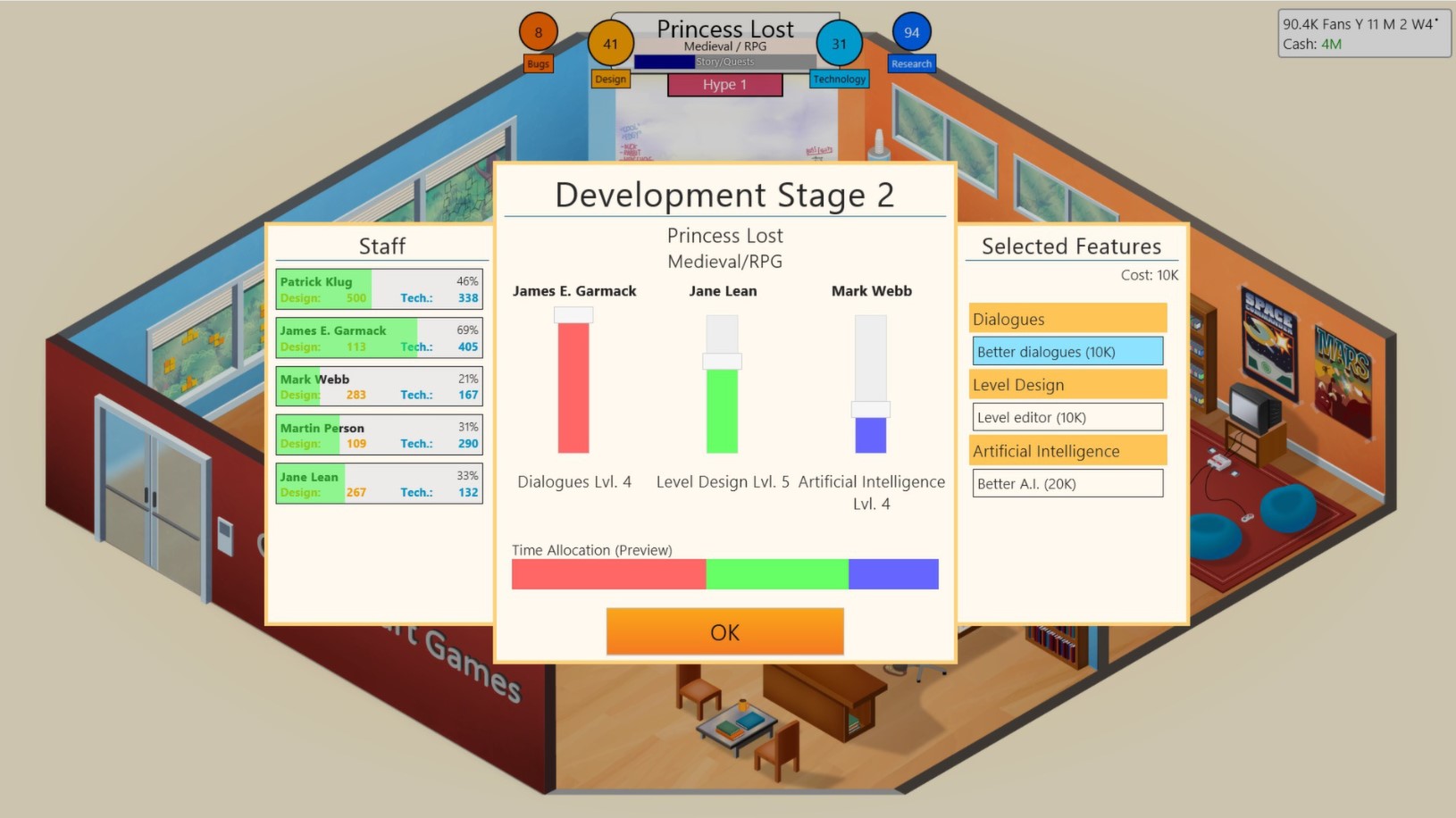
You are not meant to read the sliders. You’re meant to read the bar underneath them.
The wiki is emphatic on this point: it’s the bottom composite bar, split into three parts, that counts – not the percentage you assign to each individual slider. When a guide says “40% or more,” it’s talking about that field’s share of the bottom bar, not the slider handle position.
That single misunderstanding is responsible for a huge number of confused players following a chart correctly and getting nothing for it.
The mechanic underneath is straightforward once you see it. Time allocation determines what kind of bubbles your staff generate.
If you assign 50% of a phase to Dialogues, 30% to Level Design, and 20% to AI, then for that first 50% of the phase your employees produce roughly 90% design bubbles and 10% tech; during the 30% stretch it flips toward 40/60; and in the final 20% it’s around 20/80.
You’re not setting quality – you’re scheduling what kind of points get made and when.
| Genre | Focus | Phase priorities |
|---|---|---|
| RPG | Design | Gameplay + Story/Quests high, Engine low; Dialogues + Level Design high, AI low |
| Adventure | Design | Story-forward throughout |
| Simulation | Tech | Engine + Gameplay high; Level Design + AI high, Dialogues low |
| Strategy | Tech | Same broad shape as Simulation |
| Casual | Design | Gameplay and Level Design lead, nothing extreme |
| Action | Mixed, graphics-critical | Graphics matter more than most genres |
One useful note on Phase 3: Sound is the slider most players deprioritise, and it’s still needed to reach a perfect 10 from Informer. If you’re stuck at 9s and can’t work out why, that’s a common culprit.
And multi-genre changes the math in a way most people miss. The first genre you pick counts twice as much as the second. The genuine appeal of multi-genre isn’t synergy – it’s that combining genres cancels out requirements. Strategy/Adventure and Strategy/RPG end up with only three constrained fields, where single-genre Strategy or RPG saddles you with six positives and a negative to manage. Fewer rules means more freedom to include what you want.
Factor Two: Combos, and Why Some of Them Are Nonsense
Certain topic/genre pairings are flagged as Great Combinations and hand you a significant score multiplier. Game Dev/Simulation, Dungeon/RPG, and Airplane/Simulation are classic examples. Mismatches like Racing/RPG or Vampire/Casual do the reverse.
The broadly reliable ones people fall back on are Fantasy + RPG, Sci-Fi + Action, and Sports + Simulation, largely because they combine strong synergy with wide audience appeal.
Now, an honest tangent, because the combo table is genuinely a bit silly in places. A Steam thread from 2019 makes the case well: Detective and Strategy isn’t a good combo, which is odd for a genre defined by working things out. The poster’s line about L.A. Noire supposedly requiring no strategy at all is a fair jab. Mystery works with RPG but not Strategy, which is arguably backwards.
The reply in that thread is the important part, and it’s why you should just memorise the tables rather than reason from first principles: development stopped years ago. These pairings aren’t going to be revised to match intuition. Some of them don’t make sense and never will. Learn them as arbitrary facts, not as design logic.
Factor Three: Bugs, Which Are Worse Than You Think
Bug fixing is the phase everyone rushes, and the penalty formula shows why that’s expensive.
The community’s reverse-engineering of the review algorithm gives a bug modifier along the lines of r = 1 − (0.8 × [bugs × 100 ÷ (Tech + Design)] ÷ 100), with the bracketed portion clamped between 0 and 100. If r drops to 0.6 or below, a “riddled with bugs” message enters the review queue. Below 0.9, you get a “too many bugs” complaint.
Read what that means practically. The penalty scales against your total points, so a big-budget game with a handful of bugs is fine, while a small game with the same bug count gets hammered. The purple icons aren’t optional cleanup. Shipping broken tanks your sales.
There’s a positive counterpart worth knowing too. If you spend more than 40% of a phase – again, on the lower time allocation bar, not the slider – on a design goal weighted at 0.9 or higher, and you do it at least twice, your quality gets a bump and you’ll see a message about the focus serving the game well.
Factor Four: The Five Ways to Quietly Ruin a Game
These are the repetition penalties, and they’re the reason a formula that worked last year suddenly doesn’t. The long-standing community guide lists them cleanly:
- Two or more games in a row with the same genre/topic. Never repeat back-to-back. Diminishing returns hit even if your engine improved.
- A sequel or expansion within a year of the original. Space them out.
- Large games on 2D Graphics V3 or lower, or 3D Graphics V2. Your engine has to match your ambition.
- An AAA game without 3D V6. Non-negotiable.
- An AAA game without all employees specialized. Also non-negotiable.
Add one more from the combo guides: never make a sequel using the same custom engine as the original. Players notice, and so does the review algorithm.
That first rule is the one that catches everybody. You find a combo that scores 9, you’re delighted, you run it again immediately, and the score collapses. Nothing broke. You just repeated yourself.
Staff, Research, and the Timeline This Game Dev Tycoon Guide Runs On
Late game is where staff quality overtakes everything else, and specialization is the gate.
To specialize an employee on a specific slider they need to be level 7 and meet design and technology thresholds. It costs 200 research points and 5 million credits per person. Not cheap, and you’ll need it done across the whole team before AAA is viable.
The useful structural insight is that specialization requirements are proportional to the design/tech components of each dev focus – so the requirements themselves tell you which employee belongs on which slider. Great games want some staff focused on design, some on technology, and some genuinely balanced. Save the balanced ones for Stage 3.
The progression timeline reported by the community guide runs roughly like this. The second office needs 1 million. Its upgrade wants Year 11, Month 6, Week 2, with two employees and 5 million. The next office asks for Year 13, Month 9, Week 2, four employees, and 16 million. The R&D Lab requires a Design Specialist; the Hardware Lab requires a Technology Specialist afterward.
Research unlocks land on their own schedule – Target Audience early in Year 3, Casual Games late in Year 3, Marketing in Year 4, Sequels around Year 8, Multi Genre around Year 12. Expansion Packs need you to have researched MMO and have one on sale. Within the R&D Lab, Hardware comes first, then Internet, then Opportunities, MMO, and Codename: Grid follow.
The practical takeaway: you cannot rush the mid-game. Those unlocks are time-gated as much as money-gated, so the winning play is surviving comfortably until they arrive rather than trying to sprint past them.
A few habits that hold up across playthroughs:
- Take publisher contracts early if fans are thin. They’re unglamorous income while you build a reputation.
- Upgrade office computers to improve development efficiency – an easy return that people forget.
- Give staff vacations after crunch to avoid burnout tanking your output.
- Match platform to genre. PC suits simulation, the action-oriented consoles suit action, handhelds suit casual. Market share and dev cost both factor in.
- Do game reports. They’re how the game teaches you its own suggested ratios, and they’re why your second playthrough goes so much better than your first.
FAQ
Why do my scores drop even with a good combo?
Almost always repetition. Making two games in a row with the same topic/genre triggers diminishing returns, regardless of how much your engine improved.
What’s the tech/design ratio supposed to be?
It depends on genre, not balance. RPG and Adventure lean design – roughly two-thirds design for RPG. Simulation and Strategy lean tech.
Do the sliders themselves matter?
Less than the composite bar beneath them. Guides quoting “40% or more” mean that field’s share of the bottom bar, not the slider position.
How much does specialization cost?
200 research points and 5 million credits per employee, and they need to be level 7 with the right design and tech levels.
Is multi-genre worth it?
Yes, mainly because it removes constraints. Combining genres reduces the number of fields bound by rules, giving you more freedom. The first genre counts twice as much as the second.
What do I need before attempting AAA?
3D Graphics V6 and every employee specialized. Missing either results in a penalty.
Why do some combos make no sense?
Because development ended years ago and the tables were never revised. Detective/Strategy being a poor match is a known community grumble. Memorise them rather than reasoning about them.
Wrapping Up
The thing that changes how you play the Game Dev Tycoon guide is realising the score isn’t a vibe check – it’s arithmetic, and the community has already done the reverse-engineering for you. Get the tech/design ratio right for your genre, stop repeating yourself, clean up your bugs relative to your game’s size, and specialize your staff before you reach for AAA titles. The sliders will still be there to fiddle with, and they still help, but they’re the last five percent rather than the first fifty. Chase the ratio first, and the 9s stop feeling like luck.
P.S. If this turned a frustrating 4/10 into something you can actually diagnose, sharing it around is the simplest way to keep our small team producing guides that dig this far into the maths. Bookmark it too, because the ratio and penalty sections are the bits you’ll want to re-read three playthroughs from now when a reliable combo mysteriously stops working. And if creative or commercial collaboration is what brought you here, the BandurArt team is always happy to hear from you directly.